Posts

Showing posts with the label England

Munitionettes

Image
Recently, an advertisement from a page in a journal, displayed in the current  Sir George Grey Special Collections  exhibition:  World War 1914 -1918 , made me look closer. The product is soap and the accompanying illustration is not unusual or incredibly striking. It was the text which made me pause, as it reminded me of scenes in Pat Barker's novel  Regeneration . In particular, the lives of a group of munitionettes, who provide an insight into an element of home front life during the First World War. Ref:  The sphere. Vol. 76, no. 995. London: Illustrated Newspapers, 1918. Munitionettes were British women employed in munitions factories during the First World War. These women worked with hazardous chemicals on a daily basis with minimal protection. Receiving an injury or getting killed by an explosion were always possibilities. Many munitionettes worked with TNT, which after prolonged exposure, would turn their skin a yellow colour -- leadi...

Hinemihi and other wharenui from the Rotorua area

Image
During a visit to England over the Christmas holidays, I was given access to Hinemihi , the wharenui (Māori meeting house) at Clandon Park in Guildford, Surrey. The whole complex is usually closed to the public at this time of year, so I was very lucky to be given special permission to see Hinemihi. Clandon Park is an example of a Palladian mansion and was built by a Venetian architect for Lord Onslow in the 1720s. The house contains period interiors and impressive collections. Set in acres of stunning parkland, this mansion, which became National Trust property in 1956,  also contains a surprise. Located at the back of the house is a wharenui (Māori meeting house) from Aotearoa (New Zealand). Clandon Park house, January 2014, photograph by Natasha Barrett Hinemihi was built in1881 in Te Wairoa, Rotorua. The name of the wharenui comes from Ngāti Hinemihi's ancestress, Hinemihi. Aporo Wharekaniwha commissioned the carving and erection of this wharenui, which was undertaken...

The Womens Suffragette movement in NZ and Britain

Image
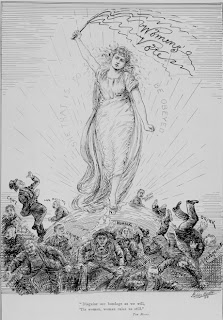
The 19th September marks Suffrage Day in NZ . This year's anniversary is extra special, since it marks 120 years since Kiwi women won the right to vote in national parliamentary elections in 1893. The Governor, Lord Glasgow, signed the landmark legislation, which made the new Electoral Act into law. In doing so, NZ became the first self governing country in the world to give women this right. Ref: 7-A12543, A cartoon by Ashley Hunter on Women's Vote, 30 Sept 1893, Sir George Grey Special Collections Also of importance during 1893, was the election of the first female mayor in the British Empire. Elizabeth Yates became the Mayor of Onehunga Borough Council in 1893 and served until 1894. She also was a councilor from 1899 - 1901. Despite the sexism Elizabeth endured her time as mayor, she made a huge impact - reduced the debt of the council, kept the streets and footpaths maintained and made an impression on Parliament when lobbying for the Onehunga Cemetery Bill. Ref...