Posts

Showing posts with the label suffrage

What kind of newspaper was the New Zealand Graphic and Ladies Journal?

Image
In May 1890 Auckland newspaper proprietor and publisher Henry Brett released a new illustrated magazine with the lengthy moniker New Zealand Graphic, Ladies Journal and Youths Companion [sic]. His new journal would be a ’lifestyle magazine’ targeted at the affluent, leisured ladies (plus discerning husbands and literate children) of New Zealand’s middle and upper classes. Brett’s vision for his new production was that it should be a high-class illustrated weekly competing with imported English illustrated journals like the Gentlewoman , Cassell’s Family Magazine and the Spectator . Consequently, the first issue of the New Zealand Graphic included serialised chapters from New Zealand author J.C. Firth’s recent book Nation Making: a story of New Zealand Savageism and Civilization , together with handsomely illustrated chapters from English novelist Wilkie Collins’s last novel, Blind Love . These stories featured alongside pages of social gossip, poetry, news and pictures of the latest...

Mere Newton and Mary Dreaver: different approaches to politics

Image
Mere Newton, local Māori politician and social worker, and Mary Dreaver, a daughter of Scottish immigrants and a national politician, operated within vastly different spheres of influence in 1937. However, Newton and Dreaver’s isolated worlds merged on 12 June 1937 when Mere Newton invited Mary Dreaver to become a guest speaker to the ladies’ social committee of the Epsom-Oak branch of the Labour Party. As the local press explained, after ‘community singing’, Dreaver took her place as guest speaker and spoke about ‘New Zealand movements of interest to women for building a new social order’. ( ‘Labour party.’ Auckland Star , Volume LXVIII, Issue 140, 15 June 1937 ). This is an excellent example of both Newton and Dreaver’s style of politics, from Newton’s utilising social connections and organising events to further causes, to Dreaver using her oration skills to further her political agenda. Image: T. H. Ashe, Onehunga Borough Council portrait, with Mere Newton in the second row, 1941-1...

Sir George Grey’s contribution to women’s suffrage in New Zealand

Image
Sir George Grey is famous as a governor, premier and benefactor, particularly for his donation to Auckland Libraries – but not famous enough for his contribution to women’s suffrage in New Zealand. Grey appears in a cameo role in a new book, You Daughters of Freedom , on how women got the vote in Australia, in 1902. At a conference considering federation (the joining of the Australian states into one country) a decade earlier, he had advised Dora Montefiore to make sure women got the vote when this happened; she became committed to that aim. Grey gets little credit on this side of the Tasman for playing a role in our campaign for about two decades, including becoming a founding (honorary) member of the Auckland Women’s Franchise League in 1892, about the same time as he inspired Montefiore in Australia. The New Zealand campaign started in 1869 when Mary Müller, using the penname Fémmina, wrote a pamphlet titled An Appeal to the Men of New Zealand . She sent a copy to ‘Sir Geo. Gr...

Women's Suffrage and Local Government

Image
2018 marks the 125th anniversary of women’s suffrage in New Zealand. On 19 September 1893, the Electoral Act 1893 was passed, giving all women in New Zealand the right to vote. However, it would not be until 1919 that women were able to stand for election to become Members of Parliament. To mark this anniversary, Auckland Council Archives has compiled an  online exhibition  which includes a timeline and photographs of the female elected representatives of the former borough, city, county, regional and district councils of the Auckland region. On 29 November 1893, Elizabeth Yates was elected mayor of the borough of Onehunga – the first woman in the British Empire to hold such an office. The Municipal Corporations Act 1876 had given all property owners and ratepayers the right to vote and to stand for election in local government. This law made no distinction between male and female property owners, thus Elizabeth Yates chose to exercise this right and stand fo...

The suffrage story of Mary Ann Gunson

Image
Today is the 125th anniversary of the day the Electoral Act was passed into law, making Aotearoa the first self-governing nation where women could vote in parliamentary elections. The 1893 women's suffrage petition was a huge part of the successful campaign for the vote. Over 30,000 women signed the petition - a small individual act that helped bring about a huge change for the wāhine of Aotearoa. In 2018 we celebrate the action they took by researching and telling their stories. Below is the story of Mary Ann Gunson, who signed sheet 21 of the petition. Her signature is fourth from the top in the image below. Her biography was written and researched by Judith Corbelletto-Thompson, who attended one of our research workshops at Tāmaki Pātaka Kōrero Central City Library. Sheet 21, Women’s suffrage petition . Image courtesy of Archives New Zealand Te Rua Mahara o te Kāwanatanga.  Mary Ann Gunson, sheet 21 Mary Ann Gunson (nee Bryne) was born in Glasgow about 1843. She ar...

The suffrage story of Harriett Garland

Image
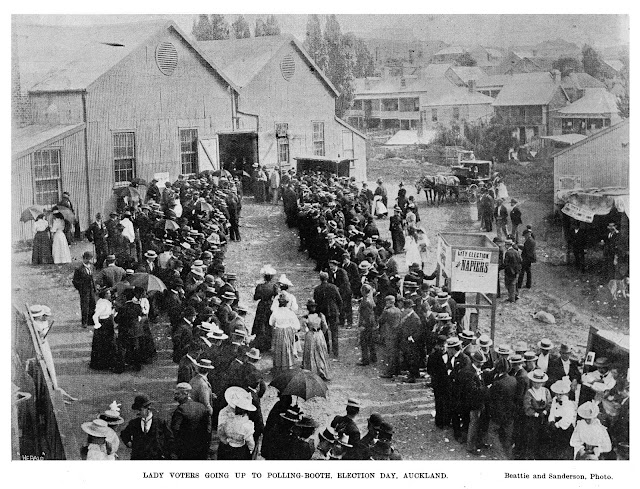
As part of our Wāhine Take Action programme celebrating the 125th anniversary of women's suffrage in Aotearoa, we recently held two suffrage story research workshops at Tāmaki Pātaka Kōrero Central City Library. The aim was to uncover stories of women who signed the 1893 women's suffrage petition  -  many of whom we know little about. By researching and telling their stories we celebrate the action they took in signing the petition - an individual act that helped bring about a huge change for the wāhine of Aotearoa. Beattie and Sanderson. Lady voters going up to polling-booth in Rutland Street, election day, Auckland . 1899. Auckland Libraries Heritage Collections, 7-A12353 . This is the story of Harriett Garland, written and researched by Donna Salmon, one of our workshop participants. Harriett's biography is also now part of the interactive display at the  He Tohu  exhibition and on the suffrage petition database at NZHistory. Harriett Garland...

Wāhine Take Action exhibition

Image
Over 125 years ago thousands of women in Aotearoa New Zealand took action by signing the 1893 Suffrage Petition , adding their individual voices to a collective call for political representation. In 2018 the Central City Library held a Heritage Collections exhibition called Wāhine Take Action, timed to coincide with Suffrage 125 celebrations across Aotearoa. Badges . 1970s and 1980s. From: Ephemera Collection, Auckland Women’s Centre. Records . NZMS 999, and on loan from the Kotare Trust – Research and Education for Social Change.  The exhibition took a broad view of what ‘taking action’ means, looking at the many different ways women have worked for social change or to support their communities. Some actions are taken individually, while others are part of larger movements. Some are explicitly feminist, some are not. All demonstrate the leadership of women in cultural, social, and political life in Aotearoa. Featured content included unique photographs, posters and letter...