Posts

Showing posts with the label volunteers

Military Service Act of 1916
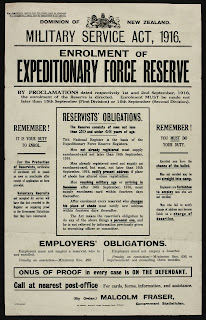
Image
One hundred years ago today, 1 August 1916, conscription was introduced to New Zealand through the Military Service Act. The first names were drawn under the Act on 15 November 1916, and monthly ballots were repeated for the remainder of the war. As you can see from the poster, there were serious consequences for those who did not enrol. Ref:  Flyer.  Military Service Act, 1916 . From: Lusty family.  Collection of newspapers and ephemera, Sir George Grey Special Collections, Auckland Libraries,  NZMS 1387.

The first five men

Image
On Sunday afternoon 26 April five armed and mounted men clattered down the main street of Waiuku. Ref: Bruce Ringer, Outside the Kentish Hotel, Waiuku, 2015. The occasion was not a bank robbery nor a gymkhana but a reenactment, 101 years after the event, of a locally famous photograph taken of the first volunteers to leave Waiuku for active service during the First World War. Ref: Volunteers, Waiuku, August 1914, photograph reproduced courtesy of Waiuku Museum Society, South Auckland Research Centre, Auckland Libraries, Footprints 04686. These five men posed on their horses outside the Kentish Hotel on 17 August 1914. Captain John Henry Herrold of the Waikato Mounted Rifles is on the far left. He is accompanied by, from left to right, Troopers Frank Knight , Robert William ('Bob') Hammond , Alexander Glass and Henry Eisenhut . If you would like to add to the records of these first five men, you can do so at the Online Cenotaph website or keep an eye out for ...

NZ Women who fought against WWI

Image
The declaration of war was greeted so enthusiastically in NZ that many anti-militarist groups lowered their profile. This included the National Peace Council, whom in 1914 suspended all public work, saying “the war fever is too acute to allow of any meetings being held” (Hutching, M., 2007, see full reference below). Most NZ women supported the war effort, but some were bold enough to agitate for international arbitration and an end to war. The Canterbury Women’s Institute , the Women’s International League and The Housewives Union formed part of the nucleus of the anti-war movement in NZ. Ref: Front cover of Women for Peace & Freedom by Betty Holt (1985) 

Music and the First World War

Image
Music in the First World War played a number of different roles on both the battlefields and back on the home front. On a basic level, music was a good form of entertainment and was a focus for social gatherings. Due to its popular nature, music is able to infiltrate into all aspects of life. During the war, governments quickly saw its potential to inspire a sense of national pride, patriotism , to promote recruitment for soldiers and garner support for fund raising efforts. It was also used as a powerful way to shame conscientious objectors and others who didn't support the war. The catchy melodies and rhythms can therefore be seen as a form of propaganda. Most songs from the First World War period did not reflect the brutal reality of war, instead they suggested that all would be fine and that the war would end soon. Ref: Natasha Barrett, military band at Auckland War Memorial Museum, Anzac Day, 25 April 2010

C Company 28 Māori Battalion Memorial House to be built

Image
Ref: AWNS-19400703-31-1, new recruits to the Maori Battalion in training & leisure at the Papakura Camp, 1940, Sir George Grey Special Collections Half a million dollars will be contributed by the government towards the construction of a C Company 28 Māori Battalion Memorial House on land adjacent to the Tairawhiti Museum . This recognises the huge contribution of C Company to the nation and its special place in NZ history. Ref: AWNS-19430526-13-3, members of the Maori Battalion help clear up the bomb-torn waterfront of Tripoli, 1943, Sir George Grey Special Collections The concept design also recognises the sacrifice by Horouta Waka District Māori in other conflicts including: The Boer War, WW1, Korea, Malaya, and contemporary war settings such as Bosnia, East Timor and Afghanistan.