Posts

Auckland's waterways
Image
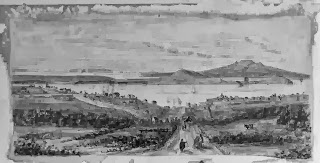
Ref: 4-4589, drawing looking north from Grafton Rd towards the harbour, showing Grafton Road ( foreground), Symonds St, (left), Mount Victoria, North Head & Rangitoto in the distance, c. 1886, Sir George Grey Special Collections One of the themes for the heritage festival is Auckland’s waterways, including the land and sea. The events focused on this theme celebrate water and its many guises in the Auckland region, including as a source of travel, trade, economy, recreation and more. Ref: JTD-05J-03077-2, two women sitting on a swing plank bridge over the Opal Pools Stream, 1942, West Auckland Research Centre Auckland's geography and its waterways have intimately influenced the history of the region. The Auckland isthmus was a rich and desirable location for Māori for many reasons including the rich volcanic soils for gardening and the coastal resources. Ref: B0336, James Stanley Levesque picking tomatoes from the Levesque tomato beds, Birkdale, c. 1920s, from Bir...

Auckland Heritage Festival 2013

Image
Yes, it's that time of year again when we celebrate Auckland's distinctive heritage! This year the festival runs from 28 September to 13 October and has around 240 events and activities organised by over 180 groups and organisations , many of which are free and will keep all ages amused. Contributors include Auckland Libraries, museums, historical societies, art galleries, historic homesteads and lighthouses, and events include trails, tours, workshops and talks. Ref: 2013 Auckland Heritage Festival logo The key themes around which events have been created are:: Auckland’s waterways, including the land and sea Celebrating our heritage,  including Auckland’s distinctive built, cultural and natural heritage Learning and encouragement, such as workshops and lectures.  Ref: 4-434, comparison of the Auckland waterfront in 1852 with 1900, c.1900, Sir George Grey Special Collections The public open weekend on the 28 to 29 September marks the start of the festival. Thi...

Warkworth Town Hall

Image
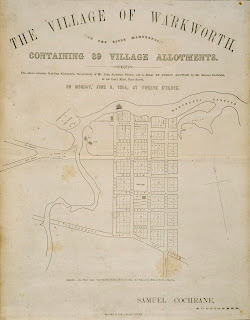
Warkworth township was established in 1853 by John Anderson Brown, a businessman from Warkworth in Northumberland, England. The area reminded Brown so much of his hometown, that he gave it the same name. Brown purchased 153 acres and drew up a plan for subdivision of the area, which included land for the Anglican Church and its cemetery. Ref: NZ Map 4498-26, map showing allotments for sale in Warkworth, 1864, Sir George Grey Special Collections Farming along with fruit farming was important to the area, but key to the success of the town was kauri timber. Another major industry was the lime and cement works, which were established in 1865 and were successful up until the relocation of the business to Whangarei in 1928. Cement made in Warkworth was used in the construction of Auckland’s Grafton Bridge in 1910, which was the largest concrete bridge in the world at the time. Ref: AWNS-18990915-8-1, view of Warkworth in 1899, Sir George Grey Special Collections

The Womens Suffragette movement in NZ and Britain

Image
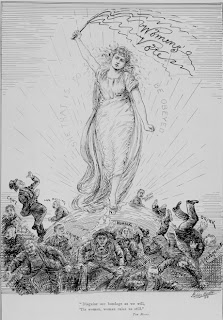
The 19th September marks Suffrage Day in NZ . This year's anniversary is extra special, since it marks 120 years since Kiwi women won the right to vote in national parliamentary elections in 1893. The Governor, Lord Glasgow, signed the landmark legislation, which made the new Electoral Act into law. In doing so, NZ became the first self governing country in the world to give women this right. Ref: 7-A12543, A cartoon by Ashley Hunter on Women's Vote, 30 Sept 1893, Sir George Grey Special Collections Also of importance during 1893, was the election of the first female mayor in the British Empire. Elizabeth Yates became the Mayor of Onehunga Borough Council in 1893 and served until 1894. She also was a councilor from 1899 - 1901. Despite the sexism Elizabeth endured her time as mayor, she made a huge impact - reduced the debt of the council, kept the streets and footpaths maintained and made an impression on Parliament when lobbying for the Onehunga Cemetery Bill. Ref...

Roald Dahl Day

Image
The 13 September was Roald Dahl Day. Each year, the focus of this day is on celebrating the life and work of Roald Dahl , one of the world's most popular and beloved writers for children. Ref: AWNS-19140122-52-4, picking friend at an orchard in Henderson, Auckland, 1914, Sir George Grey Special Collections Dahl's picture books, novels, short stories, poetry and memoirs are all classics and popular not only with children but adults too. His timeless works such as 'James and the Giant Peach' (1961), 'Charlie and the Chocolate Factory' (1964), 'Revolting Rhymes' (1982), 'Tales of the unexpected' (1980) and 'The Witches' (1983) are of enduring interest and relevance to all readers. Ref: 7-C1813, advertising poster for 'Somerdale Cube Block Milk Chocolate', made by Fry, c.1920-1949, Sir George Grey Special Collections Roald Dahl Day is a great opportunity to discover re-read a favourite or discover something you haven't...

Troopship magazines

Image
During WW1 (and indeed WW2), soldiers aboard troopships en route to war sometimes published magazines. Theses troopship magazines ranged from hand-written to professional looking publications. They were highly valued and were intended to be informative, entertaining and to help the morale of soldiers. A number were also written on the return voyages back to NZ. Ref: AWNS-19150708-47-3, 1915, NZ troopship Ludzow at Alexandria, Egypt, 1915, Sir George Grey Special Collections Auckland War Memorial Museum Library has recently completed the digitisation of its troopship magazines . These are are listed on the library's online catalogue and are also available as pdfs (simply click on the publication, then click on the link in the Notes field). Examples of the museum's holdings of troopship magazines include: 'Father Neptune's day on the New Zealand Transport 75, "S.S. Waitemata" and other items of interest / N.Z.E.F. 21st Reinforcements', 1917 (D526....

Remembering the Papatoetoe Orphan Home

Image
Fifty years ago on 5 August 1963 the Health Department's Division of Mental Health began using the former Papatoetoe Orphan Home as a hospital for children with special learning and living needs. The home, also previously and variously known as St John’s Orphanage, St Mary’s Home and the Church of England Orphan Home was now renamed St John’s Home. St John’s Home eventually became a satellite home of the Mangere Hospital (in Robertson Road) for young people with intellectual challanges. Papatoetoe Orphan Home had been laid out according to a 1907 plan by the architect George Selwyn Goldsbro’. Ref: AWNS-19070815-5-1, plan for the proposed orphanage in Papatoetoe, 1907, Sir George Grey Special Collections However because of budgetary constraints it would be built in stages.  Only three of the four dormitory blocks were built initially. (The fourth dormitory block was never built). The blocks were linked by corridors.  There was a dining hall and laundry building behind t...