Posts

Best of 2016 - Brad Argent, DNA and Identity

Image
Brad Argent (Ancestry) gave a talk in October at the Central Library on DNA. The talk came after the Family History Expo in Auckland, and was focused on the science of identity. As Brad said, DNA testing is no longer "just" a tool to help you work out your family history. It is so much more than that and it brings with it potential issues. He posed some thought-provoking questions: Does the absence of something in you change who you are, and how you see yourself? For example, if you grew up in a Māori community, and saw yourself as Māori, then get a genetic result back that says you're not Māori... do you stop being Māori overnight? He talked about the memetic self  - that is, the part of you made up of those "things" passed down to you through your culture, your family, and the family stories. What, he asked, happens when you've grown up hearing stories but learn you are not biologically connected to them? Do they just go away? Likewise, if you lear...

A collection of roses from nature, 1796-1799 by Mary Lawrance

Image
In 1799 a young woman called Mary Lawrance completed a 3 year-long project, a self-published book on roses, with all the 91 copper plates depicting varieties of roses etched and hand-coloured by herself. Image: Mary Lawrance. A collection of roses from nature, 1799. Auckland Libraries Heritage Collections .  It was purchased for Auckland Libraries in 2014 by the Mackelvie Trust, a charitable trust that supports J.T. Mackelvie’s bequest of art and decorative arts to the city. A luxurious book, it was one of the highlights in the exhibition Old and new , held in 2017 at the Central Library. A collection of roses from nature was the first book to be wholly devoted to roses, predating Pierre Redouté’s more famous book by nearly 20 years. Redoute’s book has tended to eclipse Mary Lawrance’s, with later critics damning her with faint praise. However Mary Lawrance’s book was much more unusual, being entirely her own work, from the painting to the etching, from the printing to ...

Best of 2016 - He manu hou ahau, he pi ka rere

Image
Continuing our series on Family History - the best of 2016. Here's Maata, our Māori Reference Librarian, with her "best of." He manu hou ahau, he pi ka rere – I am a chick just learning to fly The above Māori proverb describes my recent experience as a new staff member at Te Kohinga Rangahau o Tāmaki Makaurau - Auckland Research Centre , aptly. Albeit perplexing at times, my seven months navigation of the research centre and its environs, the nearby stacks, the library basement and the Sir George Grey Special Collections has been very rewarding. Also discovering the depth and breadth of the cultural and historical material within the numerous collections held on the Heritage floor has been inspiring. As an unwitting fledgling, now airborne, I feel very honoured to be a kaitiaki/guardian of this extremely important environment that is rich with the cultural heritage of Aotearoa-New Zealand, the Pacific and Great Britain. I would like to share some of the highlights ...

Best of 2016 - Arctic discoveries and NZ connections

Image
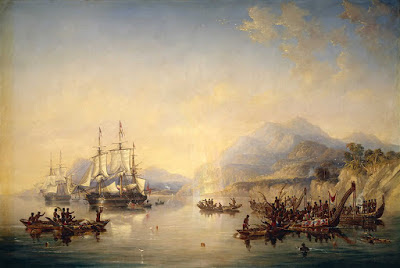
Here's another Family History Best of 2016, this time from Marie:  One of the highlights of 2016 for me was the discovery of HMS Terror in the Arctic. The Terror was sister ship to HMS Erebus and both sank in the 1840s while on an exploration voyage to find the North-west passage. While it is thought that they came close to discovering the passage, it was the subsequent voyages that went in search of the lost ships that mapped much of Upper Canada and the Arctic Circle. "Erebus" and "Terror" in New Zealand, August 1841, by John Wilson Carmichael (Public domain) Erebus is, of course well-known to New Zealanders as being the site of the largest airline fatality in New Zealand and at the time it was said that everyone either knew someone on the flight or knew of someone who had a direct link. For me, I had distant relatives and a friend’s brother who lost their lives but my link also goes back to the original ships as my three times great-grandmother’s br...

Auckland’s 1960s American-style shopping malls

Image
New Zealand’s first American-style shopping centre LynnMall opened on 30 October 1963. A 110 foot tower with a flashing red beacon marked the site which had previously been a swampy, seven-acre scrub-covered paddock. LynnMall offered a relaxed, traffic-free arrangement of shops around a weather-proof courtyard with a fountain, flowers and trees. There was plenty of seating, a free children’s play area and 500 free car parks. Three of the city’s largest retailers anchored the centre - Farmers, Milne & Choyce and Woolworths - and were complemented by 43 specialty shops such as La Gonda Fashion, Kean’s, Starforme Foundations, Masco and Curtaincraft. Ref: J. T. Diamond, LynnMall from Farmers end, November 1963, Auckland Libraries Heritage Collections, JTD-11A-02070-2 In 1965 the corner-stone was laid for a second Auckland shopping mall developed by the same company – Southmall. Farmers and Woolworths were already signed up and soon joined by a Four Square supermarket. Specia...

The great war for New Zealand, Waikato 1800-2000 / Vincent O’Malley

Image
Ref: Vincent O'Malley. The great war for New Zealand, Waikato 1800-2000,  Bridget Williams Books, 2016, Auckland Libraries, 993.3 OMAL. On 12 July 1863 British Imperial Army troops crossed the Mangatāwhiri River which marked the boundary between British occupied territory and land under the authority of the Kingitanga (the Māori King movement). The crossing of this boundary by military troops, just south of the city of Auckland, was a declaration of war. The invasion of the Waikato had begun. Ref: Sketch map of the North Island of New Zealand, shewing approximately the loyal and rebel districts, 1869, Auckland Libraries Heritage Collections, Map 2563a.   Vincent O’Malley’s latest work The great war for New Zealand: Waikato 1800-2000 provides a vast repository of research to support his view that the Waikato war, the epicentre of the New Zealand land wars, was the defining conflict in the history of Aotearoa New Zealand. He believes that the war had a greater imp...

The life and times of the Farmers Santa

Image
The team who built the giant Farmers Santa in 1960 would be amazed at the icon’s fluctuating fortunes . The statue enjoyed a 30 year run until the store’s Hobson Street site was sold (now the Heritage Hotel). He relocated to the Manukau Shopping Centre and was sacked for being too tatty, then taken apart and left in a rigger’s yard. Santa was later sold for $1; renovated for $40,000; restored again for $100,000; and had his winking eye and beckoning finger removed. He was the world’s largest fibreglass Santa in 1960; and crowned the world’s creepiest Christmas ornament in 2011. Ref: Coloured postcard of the Farmers Trading Company, 1970s, Sir George Grey Special Collections, Auckland Libraries, 9-1.