Posts

Early record of Auckland democracy

Image
The Auckland Library Heritage Trust has recently acquired a printed, annotated burgess roll for the City of Auckland for 1887 to 1888 that is believed to be unique. They have kindly lent it to Auckland Libraries where it is currently on display in the Heritage Collections reading room at Tāmaki Pātaka Kōrero, the Central City Library. Stamped ‘Mayor’s Office’ in gilt on the binding, the roll is preceded by a manuscript list of 32 alterations authorised by council between May 1887 and April 1888. In most instances these correspond to amendments in the six individual ward rolls within the volume. No copy of this roll is held by the National Library or the Alexander Turnbull Library in Wellington, nor by any other Auckland research library. Auckland Libraries, Council Archives and Auckland War Memorial Museum have the most comprehensive collections of rolls, though wards are missing for some years in what has survived. Council Archives’ rolls cover 1872 to 1899 (series ACC 396). Manu...
The saga of Boyd’s Zoo

Image
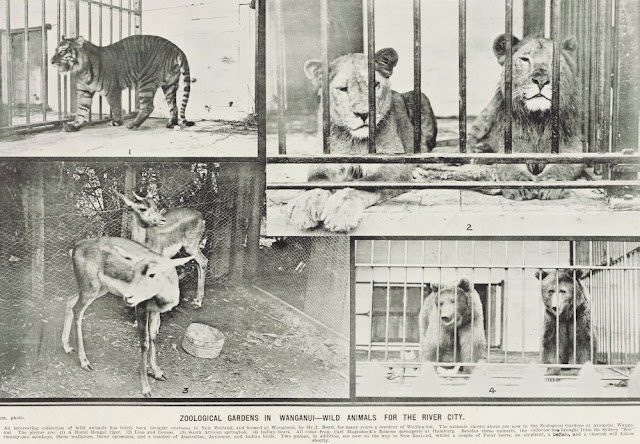
Boyd’s Zoological Gardens was a commercial enterprise established by John James Boyd in Upper Aramoho, Whanganui in 1909 after he had imported a lion and lioness, a tigress, and breeding pairs of bears and black buck antelopes, together with four macaws, two vultures and two demoiselle cranes from a zoo in Hamburg, Germany. The New Zealand Graphic published the following photo of some of his animals in the recently opened zoo in their issue on 9 February 1910: New Zealand Graphic. Zoological gardens in Wanganui, 1910. Auckland Libraries Heritage Collections, NZG-19100209-19-1 . Soon he must have expanded his menagerie because a photo published by the Graphic of 13 July 1910 includes an emu. This photo also shows his vultures: New Zealand Graphic. In the Wanganui zoo – an interesting collection, 1910. Auckland Libraries Heritage Collections, NZG-19100713-23-1 . However Upper Aramoho did not prove to be a good location, with poor attendances at Boyd’s zoo. Early next year...

Snow in Northland

Image
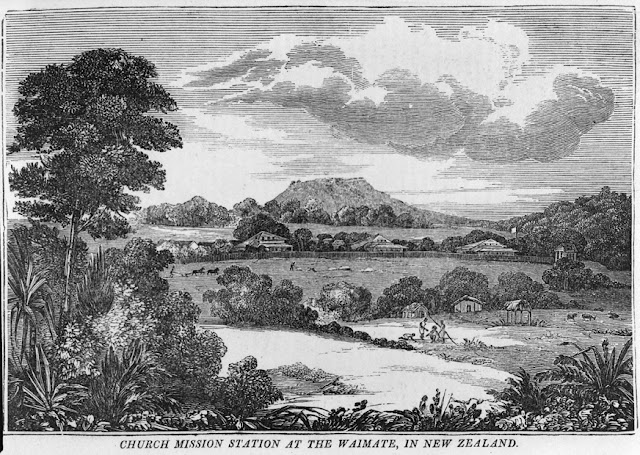
On 30 July 1849, Richard Davis, an Anglican missionary in the Bay of Islands, made this surprising entry in his daily weather diary : “Hail storms. This morning the southern hills and Poutahi covered with snow.” The next day, he noted that the hills were “again covered with snow.” The Davis family - Richard and Mary and their children - lived at the Church Missionary Society’s station at Waimate North, inland from Paihia, and the snow he referred to had just fallen on the hills behind the small mission settlement. It wasn’t the only extreme weather he would record in the nine years he documented Northland’s climate, but it was probably the most unexpected. Image: James Richardson. An engraving from the Missionary Register showing the mission station at Waimate with Bishop Selwyn's house, left of centre. Auckland Libraries Heritage Collections, 4-1274.  There are two weather registers by Richard Davis in Special Collections at the Central City Library, and together...

Tactile Verse: Aotearoa Letterpress Poetry Books

Image
The three-dimensional bite of metal type into paper gives text a sculptural depth that brings new life to poetry. Who can resist the urge to run their finger along rows of impressed text - engaging with the words both physically, and as a reader? This union of 15th century printing technology and contemporary Aotearoa poetry and visual art has resulted in a range of beautiful hand crafted books, key examples of which can be viewed in the Angela Morton Room | Te Pātaka Toi Art Library. the fruits of (2009) Typographer Tara McLeod has said the printer’s challenge is to find the letterforms that are right for a given message. He and poet Riemke Ensing have collaborated on many collections, and Ensing has noted that “Not only is there an absolute commitment to retain the integrity of the work [by McLeod] and convey the feeling inherent in the poem, there is that sensitivity to the use of colour, light, space and form to capture the essence of the poems in these new and startling en...

McCallum’s chip

Image
Image: Di Stewart. Jervois Road, Herne Bay, Auckland, showing a footpath covered in red stone chip, 1996. Auckland Libraries Heritage Collections, 802-13-11. While walking in the city, I scan my environment like I do while walking on the beach. I actively look for interesting patterns and curiosities. One day my eye tuned into a ‘red stone’, I saw it everywhere: as loose stone chip, in concrete foundations, floors and small ready-mix concrete applications; The council uses it on road islands, in concrete for raised pedestrian crossings and down the shoulders of the motorway. Albert Park is completely paved in this loose red chip. The more I looked the more I saw it. Image: Finn McCahon-Jones. Piece of footpath covered in red stone chip. Collected in Surrey Crescent, Auckland, 2003. This red stone, I would argue, is as iconic as the Mt Eden basalt kerbstones seen around the city, and as easily identifiable. This ubiquitous stone has become part of the aesthetic of the Au...