Posts

What’s in a building? Chelsea Sugar Refinery and Estate’s journey to heritage recognition

Image
Nestled on the Northern bank of the Waitematā Harbour is one of Auckland’s most iconic landmarks. Protruding loudly from the native bush and regenerating forest of the surrounding Chelsea Heritage Park, the large, questionably-coloured buildings which make up the Chelsea Sugar Refinery in Birkenhead are hard to miss from its seaward side. Everyday, they serve as a stark reminder to the thousands of commuters and day-trippers who cross the Harbour and residents of the adjacent beaches of Herne Bay that the North Shore, known for its ever-expanding low-rise suburbs and idyllic East Coast bays, is also responsible for producing one of New Zealand’s most-loved commodities: Chelsea Sugar. Indeed, today, the sugar works produces and distributes more than 160,000 tonnes of sugar per year to kitchens throughout New Zealand. Image: Chelsea Sugar Refinery, Birkenhead, as viewed from the Waitematā Harbour. 1980s. Auckland Libraries Heritage Collections, B0116 .   Image: Chelsea Sugar Refinery...

Douglas MacDiarmid: Coming full circle

Image
A sense of place is important to most of us and particularly so for expatriates such as painter Douglas MacDiarmid who lived most of his life in France but never lost touch with his ‘New Zealandness’. On the eve of his centenary, Takapuna Library’s specialist Angela Morton art history collection has drawn from its substantial trove of MacDiarmid materials and memorabilia to profile this remarkable expressionist painter’s connections to his homeland, and especially to the Auckland North Shore and Piha communities, through his art, writings, photographs, significant friendships and other personal memorabilia.  Image: Douglas MacDiarmid with Bathers, early 1960s. Private collection.  Douglas Kerr MacDiarmid was born in Taihape on 14 November 1922, the younger son of Dr Gordon and Mary MacDiarmid. He read prolifically, drew and painted from a young age, enthralled by sensuality and the beauty of landscapes and the human form, and had a fervour for the ancient world as the source o...

What do you know about that, now? The rock, the Rona and the parrot

Image
The dark night of Monday 26 June 1922 was Auckland’s night to remember. However, our local hazard was not a drifting iceberg, but Flat Rock near Kawau Island in the Hauraki Gulf. The Colonial Sugar Refining Company’s steamer Rona had arrived from Fiji with 7000 tons of sugar and 600 tons of molasses and was heading towards the Rangitoto channel preparing to offload at Chelsea Sugar Refinery. The crew of the Rona had sailed this route many times before. The lookout reported they were approaching Flat Rock beacon, but the ship always passed close to it. However, this time the mate at the wheel was trying to avoid an oncoming trawler and steered too close to the shoal running out south-westwards from the rock. The ship ran aground on Flat Rock approximately 30 feet from the Flat Rock beacon. You can see how close the bow of the ship was to the beacon in the following dramatic photos published by the Auckland Weekly News. Image: Auckland Weekly News. Flat Rock beacon dead ahead, 6 ...

Local election advertising through Auckland’s history

Image
Most readers will have received their voting papers for the current local elections, and everybody will surely have seen the masses of leaflets, hoardings and newspaper or social media ads from the various candidates. Electoral communication is one of the fundamental tools which allow voters to navigate the intense competition between ambitious candidates – but it wasn’t always this way. At the first local election in Auckland, for the brand-new Borough of Auckland in 1851, the soldiers in the Fencible settlements voted for their officers and the civilians voted for their neighbours. In the Epsom East ward, the farmer Joseph Newman defeated another settler, James Williamson, by four votes to one. In the second election, a year later, the novelty value had disappeared: six wards out of 14 had only one candidate to choose from. And seven had none at all. Image: A personal message from Robbie's Team of United Independents. From:  Elections - Local Government 1958-1962 . Ephemera Colle...

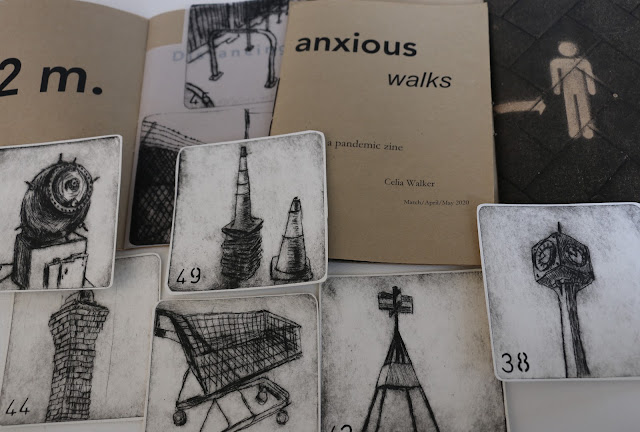
Shelter in Place by Celia Walker

Image
Shelter in Place in the Angela Morton Room at Takapuna library brings together a group of artist books by Auckland printmaker Celia Walker. Landscape, environment and cultural history feature in the exhibition, reflecting the artist’s interest in the complex layers that comprise the urban landscape.  A researcher with a background in archives and histories of landscape, including an art history PhD, Celia can’t help but be influenced by heritage. She is interested in the way each place carries with it stories of our cultural landscape through oral, archaeological and documentary records.  The exhibition also has a cartographic thread – the unfolding and layering possibilities of book structures hint at the passage of time or the movement through space. Although there is an aesthetic appeal in the depiction of underlying structures and forms in maps like Hochstetter’s ‘The isthmus of Auckland with its extinct volcanoes’, these slip over cultural history, detaching the landscap...

The printing press poster and other lessons: printing in Rarotonga in 1849 and the Mission Press

Image
Image: Pepa 10, Grey Pamphlets, Auckland Libraries Heritage Collections “This is an announcement about the printing press. In ancient times these things were not familiar, and could only be written on parchment (skin of sheep). Then there was the printing press, in Britain in the year 1449. That was 400 years ago from then up to the present time”. This is a translation of the words on the poster shown above, printed in Rarotonga in 1849. It is a well-designed page including an ornament of a printing press which might have caused a stir, almost like a poster announcing the circus coming to town. For further context we can read about the arrival of the printing press in Rarotonga, and with it, literacy and the distribution of the Word of God, in the words of the London Missionary Society missionary, the Reverend Aaron Buzacott (1800 – 1864). His ‘Mission Life in the Pacific’ was published in 1866 and then reprinted as a facsimile edition in 1985. The chapter headings include details...