Posts

Showing posts with the label Anzacs

New Zealand Prisoners of War in Italy during the Second World War
Image
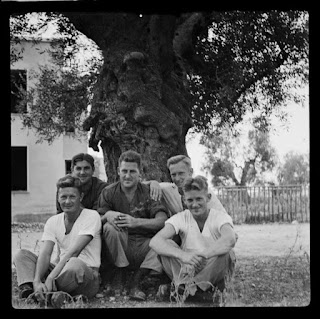
Recently a customer called into the Central Auckland Research Centre looking for a photograph of his uncle published in the Auckland Weekly News in 1943.  He said the photograph was the first indication to his family that his uncle was no longer a prisoner of war. A search of the Heritage Images database produced no results, which is not uncommon as many of the images from the Auckland Weekly News have a caption but few of the people are named. There is, however, ongoing work to rectify this.  When the Italian Armistice was announced on 8 September 1943, Colin Tayler was a prisoner of war at Campo PG 107, about 9 kilometres north of Schio in Northern Italy.  Over the next three weeks he and his travelling companions, Privates D R Muir, R Kendrick, I Penhall and E Barnett, travelled approximately 566 kilometres south: by train to Pescara on the Adriatic coast, before walking some distance and catching another train as far as they could go.  They met allied s...

Christmas time

Image
It’s that time of year again, the halls are decked and the streets are decorated. Ref: Eric W Young, Looking south along Queen Street..., 1980s, Sir George Grey Special Collections, Auckland Libraries, 1021-52.

The Emden and the ones who got away

Image
SMS Emden was a German light cruiser and commerce raider in the Indian Ocean during the early months of the First World War. Ref: Auckland Weekly News, Destroyer of five British merchant ships..., 1 October 1914, Sir GeorgeGrey Special Collections, Auckland Libraries, AWNS-19141001-48-1. After destroying 25 merchant vessels and 2 Allied warships, Captain Karl von Müller of the Emden decided to sail to Direction Island in the Cocos Island group and destroy the cable station there, with the aim of disrupting Allied communications and making the hunt for his ship even more difficult. Ref: Auckland Weekly News, Captain Karl von Muller, 24 December 1914, Sir George Grey Special Collections, Auckland Libraries, AWNS-19141224-40-1.

Chunuk Bair Centenary: Once on Chunuk Bair

Image
Today, 8 August, marks the 100 year anniversary of the Battle for Chunuk Bair . The battle, which took place from 6-10 August 1915, was New Zealand’s most significant action in the Gallipoli Campaign . To help commemorate the anniversary of the battle we are taking the opportunity to look back on the premier performance of Maurice Shadbolt's only published play,  Once on Chunuk Bair.  The first performance of  Once on Chunuk Bair  was given at Mercury Theatre , Auckland, on 23 April 1982. The play was directed by  Ian Mune  and designed by Richard Jeziorny. Two manuscript collections held in Sir George Grey Special Collections are useful in looking back to this initial staging of the play. The first is the Roy Billing papers , who was the lead actor in the 1982 performance. This collection includes draft scripts of the play as it was performed at the Mercury Theatre, complete with Billing's annotations as well as an extract from his unpublished memoir, ...

First photograph from Gallipoli

Image
This photograph from the Auckland Weekly News Supplement (AWNS) depicts first aid being applied to an ANZAC soldier on the sloping terrain of Gaba Tepe on the Gallipoli Peninsula on 25 April , 1915. Published on 24 June 1 915, one hundred years ago today, it is considered the first newspaper image of the Gallipoli campaign and is attributed to Private Robert Blackwood Steele  of the Auckland Infantry Battalion . Ref: R.B. Steele for the Auckland Weekly News, New Zealanders in action, 24 June 1915, Sir George Grey Special Collections, Auckland Libraries, AWNS-19150624-35-1. 

News from the Dardanelles

Image
On 29 April 1915 Prime Minister Massey announced in Wellington that four days earlier New Zealand troops had participated in the landings on the Gallipoli Peninsula in the Dardanelles. However actual photographs of military activities and living conditions at Gallipoli were sparse in the Auckland Weekly News Supplement until late July 1915. There were photographs of the naval warships trying to force a passage through the Dardanelles and bombarding the Turkish forts there. There was also the Roll of Honour; and its seemingly never-ending portraits of casualties must have alerted readers that something BIG was happening. But either distance, censorship, early lack of official photographers or the simple fact that the troops  couldn't  easily get their films developed meant the  Auckland Weekly News could only gradually reveal the campaign to its readers as events unfolded. This little piece might shed some light on how Auckland Weekly News readers learned about life an...

Maps of Gallipoli

Image
Sir George Grey Special Collections hold a number of First World War maps of Gallipoli and surrounding regions. Seven of these maps have been digitised and are accessible via the Heritage Images database. In April 1915, New Zealand soldiers, alongside those from Australia, Britain and France, invaded the Gallipoli Peninsula. This was to ensure an Allied naval force could break through the Dardanelles Strait and seize or threaten the Ottoman capital of Constantinople, and hopefully the Ottoman Empire might be forced out of the war. The British landed at Cape Helles on the southern tip of the peninsula, while the Australian and New Zealand Army Corps (ANZACs) landed half way up the peninsula, in order to cut off the Ottomans’ supply route to the south. Neither force managed to achieve their primary objectives and the conflict soon turned into a stalemate of trench warfare. Ref:  The Daily Telegraph picture map of the Dardanelles... , 1915, Sir George Grey Special C...

Anzac Day

Image
This year's Anzac Day takes on special significance with the start of the upcoming centenary of the First World War being marked in August. The library also has a range of heritage images showing Anzac Day scenes over the years, such as services, parades, memorials and banners. You can search for these by using the keyword Anzac in the search box of  the heritage databases:  Heritage Images , Local History Online and Footprints . We have put together a selection for you below and as you look through these, take a moment to remember all the servicemen and servicewomen who have served for their country. Services: Ref: Photographer unknown, Anzac Day ceremony, Papatoetoe, c. 1970s, photograph reproduced by courtesy of Mr Neil Closey (via Cheryl Fowler), South Auckland Research Centre, Auckland Libraries, Footprints 01506 Ref: Photographer unknown, Anazac service, Auckland Town Hall, corner of Greys Ave and Queen St, c. 1922-1929, Sir George Grey Special Collections...

Anzac Day

Image
First marked in 1916, Anzac Day commemorates all the New Zealanders killed in war and it also honours returned servicemen and women. The commemoration date, 25th April, remembers the date that the New Zealand and Australian soldiers or the Anzacs landed on the Gallipoli Peninsula in 1915. To commemorate and reflect upon this important day, here are a selection of Auckland Libraries' heritage images relating to Anzac Day, which are drawn from around the region and across the decades. West: Ref: JTD-11K-01640-2, unveiling of New Lynn War Memorial on Anzac Day, 25 April 1958, West Auckland Research Centre Ref: JTD-05J-03183, trampers at remains of wartime road block, Karekare, 1945, West Auckland Research Centre Ref: JTD-04K-03812, unveiling of War Memorial on Lion Rock, 1920, West Auckland Research Centre North: Ref: N0111016, Anzac Day gathering, Northcote, 1920s, North Auckland Research Centre Ref: T1172, barbed wire defences on Takapuna Beach during World...