Posts

Showing posts with the label Second World War

Forged in Fire: The War Effort and Sudden Success

Image
The story of Crown Lynn begins as one of classic New Zealand innovation. Its trajectory throughout the 1940s is characterised by aspiration and enterprise, as well as a connection to foreign affairs that would last the company’s lifetime. Crown Lynn’s ascension from a Hobsonville brick-and-pipe works to New Zealand’s preeminent pottery was the result of industry, innovation, and constant reassessment of their techniques. The nascent company identified where they could improve, hire people, or find equipment that would progress their craft. And, despite all of this, it never could have happened without the economic vagaries of the Second World War. This research project looks at the perennial link between economic conditions and fortunes at Crown Lynn, specifically their reliance on economic protections. The Second World War acted as a microcosm for these forces, with a complete ban on nonessential imports facilitating their rise from one of many pottery companies on the New Lynn scene ...

Ngako: The Collections Podcast

Image
Ngako: The Collections Talk is a documentary film and podcast series showcasing taonga in Auckland Libraries’ heritage and research collections.  Explore the whole series in our current exhibition , on until 2 March 2024 at Tāmaki Pātaka Kōrero, the Central City Library. This audio playlist contains all the episodes from Ngako: The Collections Podcast, where we explore items and stories from Auckland Libraries Heritage Collections. Wanderlust - the war years In this episode we find meaning and history in the Auckland Tramping Club’s newsletter Wanderlust.  Archivist Sharon Smith shares insights gleaned from reading the Wanderlust magazine in the period of publication during the Second World War.  We are also joined by current Auckland Tramping Club members, Ian, Anna and Dennis, on the Club’s programme of tramps and their preparation for the upcoming Club centenary celebrations. Listen to the track here . Ava, kava, kawa In this episode we explore the world of ava...

Locating Māori combatants from the Second World War

Image
Māori Battalion, march to victory … However, when entering metadata for Auckland Weekly News subject headings one of the first things to remember is that Māori combatants in the Second World War were not necessarily members of the 28th Māori Battalion. There were Māori soldiers in other battalions or army units, Māori airmen in the Royal New Zealand Air Force and Māori sailors in the Royal New Zealand Navy (although I have only finished from 1939 to 1942 so far and have not come across any Māori sailors in the Roll of Honour yet; and the war is still a work in progress!). Using a few servicemen, here are some examples of the way we can find extra information about Māori combatants from the Auckland War Memorial Museum’s Cenotaph Database and the battalion roll on the 28th Māori Battalion website . The 1942 Roll of Honour contains three Māori airmen. The first we come across is Sergeant Herbert Samuel (or Bert Sam) Wipiti. Before the war Bert was a junior refrigerati...

Gorgeous Girl Shows

Image
For a brief time in the 1940s Auckland dancers performed Gorgeous Girl Shows wearing little more than G-strings, balloons and fans, to packed houses of appreciative American servicemen. Image: The Pony Dancers. From: The New Zealand Herald, 9 August 1975. Auckland Libraries Heritage Collections. Over half a million GI’s arrived in New Zealand for rest and recuperation between June 1942 and the end of WW2. They were keen to be entertained in the city’s nightclubs and dance halls and made a beeline for The Civic Theatre’s Hollywood-style floor shows. The theatre’s 3,000 tickets often sold out within an hour. Patrons watched the latest movie then the Civic’s golden barge rose from the depths bearing an orchestra, dancing girls, and “star, Freda, in peacock-feathered headgear, posing as the stem of a huge champagne flute.” Image: Clifton Firth. Freda Stark, 1947. Auckland Libraries Heritage Collections, 34-409. Freda Stark became an overnight sensation after a costume malfunc...

Wrap-up of the 2016 Trans-Tasman Anzac Day blog challenge

Image
On Monday, 18 April 2016, I issued my annual Trans-Tasman Anzac Day Blog Challenge . It's where I invite people to submit their blogs, written from their research about family members who served in the wars. This year it was the centenary of the First Anzac Day. Our remembrance day that we share with our mates across the ditch. Attendances at commemorations were at a record high throughout New Zealand; and from what I have read, they were in Australia too. It's thought provoking to see so many children and young people taking part in the march, the ceremony, or just as part of the crowd. A large number wearing medals of grandparents or great-grandparents... What is it about Anzac Day that interests so many young people and motivates them to get up to the Dawn Parade, or the Citizens Ceremony a couple of hours later? Sitting at the bottom of the world, with images of war on the news on TV, maybe makes war seem more real - combined with the learning the children ge...

New Zealand Prisoners of War in Italy during the Second World War

Image
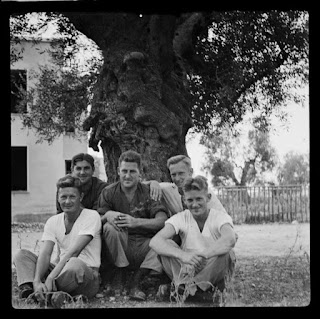
Recently a customer called into the Central Auckland Research Centre looking for a photograph of his uncle published in the Auckland Weekly News in 1943.  He said the photograph was the first indication to his family that his uncle was no longer a prisoner of war. A search of the Heritage Images database produced no results, which is not uncommon as many of the images from the Auckland Weekly News have a caption but few of the people are named. There is, however, ongoing work to rectify this.  When the Italian Armistice was announced on 8 September 1943, Colin Tayler was a prisoner of war at Campo PG 107, about 9 kilometres north of Schio in Northern Italy.  Over the next three weeks he and his travelling companions, Privates D R Muir, R Kendrick, I Penhall and E Barnett, travelled approximately 566 kilometres south: by train to Pescara on the Adriatic coast, before walking some distance and catching another train as far as they could go.  They met allied s...

It's not a census! It's the 1939 Register!

Image
Nearly two years ago, Findmypast announced that they had won the bid to work in partnership with the National Archives to digitise the 1939 Register for England and Wales . Many researchers hadn't heard of the Register before, but for those in the know, this was a huge bonus and would make a big difference to our research. Since then Findmypast have conserved, scanned, transcribed and digitised over 1.2 million pages from 7000 volumes representing over 41 million individual entries from over 2000 residences. Initially only available on a pay-per-view basis, the 1939 Register is now available to all annual Worldwide or United Kingdom collection subscribers.  Those that subscribe to the US, Australia and New Zealand, or Ireland collections will still have to pay per view - as will those who only subscribe on a month-to-month basis. What is the 1939 Register? The Register was a snap census taken on 2 9 September 1939 at the start of Second World War to be used to issue ide...

The HMS Achilles memorial

Image
The WW100 commemorations have drawn renewed attention to our First World War memorials. This does not mean our Second World War memorials should be forgotten: 13 December 2015 is the 75th anniversary of the unveiling of a unique and spectacular memorial at Achilles Point , overlooking the Waitematā Harbour and Hauraki Gulf. Ref: Bruce Ringer,  HMS Achilles memorial, St Heliers, 2014. 

Eating in & dining out: Dalmatian-run grill rooms of the 1940s

Image
The 1940s were boom times for Auckland’s Dalmatian-run grill room restaurants, especially after US soldiers, sailors and nurses arrived in June 1942 - there were six grill rooms on Victoria Street West alone (Clarich, Jelich, Kosovitch, Lipanovich, Makovina and Urlich) and a further 20 in the central city. The Americans came for R and R after fighting in the Pacific, for medical attention, and for training. For the next two years about 50,000 American servicemen and women were in the country at any one time. They were often paid twice as much as local wages, and had three out of every four days free. Ref: Auckland Weekly News, US troops in Queen Street, 1942, Sir George Grey Special Collections, Auckland Libraries, 7-A14390.

Auckland Libraries’ war memorial libraries

Image
At least nine of Auckland Libraries’ past or present community libraries are either war memorial buildings or have war memorial associations. The oldest of these is the Albany Memorial Library . On Peace Day 19 July 1919 a group of Albany residents resolved to build a library as their district’s war memorial. Architect Sholto Smith designed the building. Governor-General Lord Jellicoe opened the cottage-style, half-timbered structure on 21 December 1922. The library was approached via a stone arch with ‘1914-1918’ inscribed on the keystone. The words ‘Albany Memorial Library’ were displayed above the entrance. The east window commemorated the Great War. Inside, a brick fireplace incorporated a green marble memorial tablet listing the names of 23 local men who gave their lives during the First World War. (Another tablet was later added honouring seven dead from the Second World War.) The building functioned as a working library until 2004, and is still available for commun...

Artefact digitisation unit - for your Anzac!

Image
The wonderful people from the Auckland War Memorial Museum delivered an Artefact Digitisation Unit (ADU) to the Central Auckland Research Centre . A what? I hear you say . . . . It is an awesome piece of technology that looks kind of like an ATM machine - a kiosk with a computer, touchscreen monitor and a camera. With its connectivity to the internet, it has direct access to the new Online Cenotaph . People can use the ADU to search the Online Cenotaph direct from the Research Centre, and contribute information about the person they are researching - this includes the ability to photograph documents and objects to upload to a subjects record. The Online Cenotaph itself has been completed re-designed and had been re-launched in January. There are more than 140,000 service personnel listed, and alots of new content has been added: approximately 2,000 new images from Auckland Libraries' Schmidt Collection of portraits  direct links with servicemen’s sketches, po...