Posts

Showing posts with the label WW100

Auckland Weekly News Photos for 1914-18

Image
The Great War is over! Now 24,463 Auckland Weekly News Supplement photos for the period August 1914 to December 1918 have been more fully described so that they can be searched by description and subject. This means they will be more searchable and useful for librarians, social and family historians and genealogists. The photos cover that period’s social, political and military history from a New Zealand perspective. While there is obviously a national emphasis, many photos reflect this country’s involvement with international events in an important period of New Zealand’s history. This can be seen in the following Trevor Lloyd cartoon from October 1914 demonstrates New Zealand’s loyal support for Britain as they face Germany’s massive armies of mangy curs invading Belgium. Ref: Trevor Lloyd for the Auckland Weekly News, "His master's voice", 22 October 1914, Sir George Grey Special Collections, Auckland Libraries, AWNS-19141022-47-2.

In the West, Much News

Image
In late January 1929, Erich Maria Remarque’s anti-war novel Im Westen, Nichts Neues ( In the west, nothing new ) was published by Propyläen Verlag. In England the book was quickly translated by the Australian librarian Arthur Wesley Wheen and republished under the title All Quiet on the Western Front . Ref:  Two original 1929 editions that finally made it into the Library, t he one on the left is from the Quaker Collection .

Military Service Act of 1916

Image
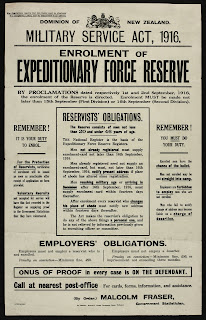
One hundred years ago today, 1 August 1916, conscription was introduced to New Zealand through the Military Service Act. The first names were drawn under the Act on 15 November 1916, and monthly ballots were repeated for the remainder of the war. As you can see from the poster, there were serious consequences for those who did not enrol. Ref:  Flyer.  Military Service Act, 1916 . From: Lusty family.  Collection of newspapers and ephemera, Sir George Grey Special Collections, Auckland Libraries,  NZMS 1387.

Manurewa's soldiers

Image
Future soldiers The photograph below was taken on the opening day of Manurewa School, 3 September 1906. This group includes a number of boys who a few years later would see active service during the First World War. Those in the back row are Walter Burton (fourth from left), Bert Ralls (sixth), Ted Mills (eighth), George Coxhead (tenth), Walter Costar (eleventh), Henry Lupton (thirteenth) and Bert McAnnally (furthest right). In the second row are Sam Craig (third from left), Douglas Wood (fourth), Horace Slight (seventh), Jack Freshney (ninth), Laurie Mills (tenth) and Fred Lupton (eleventh). Bert Mills is in the front row (tenth from left). Ref: Opening day, Manurewa School, 3 September 1906, photograph reproduced courtesy of Manurewa Historical Society, South Auckland Research Centre, Auckland Libraries, Footprints 03723. Walter Costar, Bert McAnnally, Cecil Slight and Douglas Wood would all be killed or die of wounds. Walter’s younger brother, Reginald, absent...

In and around Featherston Camp by Sir Alfred Hamish Reed

Image
100 years ago this Sunday, 24 January, the Featherston Military Training Camp officially opened its doors to men from around the country. Ref: Auckland Weekly News, New Zealand's latest training centre for recruits, 10 February 1916, Sir George Grey Special Collections, Auckland Libraries, AWNS-19160210-43-1. As part of our ongoing commitment to the New Zealand’s First World War centenary commemorations Auckland Libraries have recently a digitised a small but important resource for understanding life in New Zealand during the First World War, specifically life in the Featherston Camp. In and around Featherston Camp  by Sir Alfred Hamish Reed is a small volume written in a calligraphic hand with medieval-style ornate initials and illustrated with photos pasted on. Ref: AH Reed, In and around Featherston Camp, title page, c1917, Sir George Grey Special Collections, Auckland Libraries, NZMS 1827.

Christmas time

Image
It’s that time of year again, the halls are decked and the streets are decorated. Ref: Eric W Young, Looking south along Queen Street..., 1980s, Sir George Grey Special Collections, Auckland Libraries, 1021-52.

Auckland Weekly News Photos for 1914 and 1915

Image
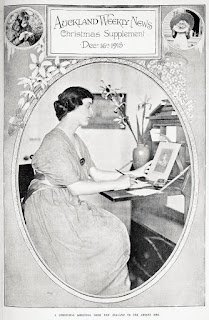
Auckland Weekly News photographs for the period August 1914 to December 1915 have now been more fully described so that they can be searched by description and subject. These photos were published in the Auckland Weekly News Supplement . There are 1,117 photos covering the period August to December 1914 and a further 7,684 photos for the period January to December 1915. Ref: Auckland Weekly News, A Christmas greeting from New Zealand to the absent one, 16 December 1915, Sir George Grey Special Collections, Auckland Libraries, AWNS-19151216-35-1.

More Tales from the South Pacific: New Zealand’s capture of German Samoa

Image
Soon after the start of the First World War, New Zealand’s Governor Lord Liverpool agreed to send New Zealand troops to capture the German wireless station in Samoa and occupy the German colony . New Zealand troops, supported by three New Zealand cruisers and three other Australian and French warships, took possession of German Samoa on 29th August 1914. Ref: Auckland Weekly News, The British occupation of Samoa, 29 August 1914, Sir George Grey Special Collections, Auckland Libraries, AWNS-19140917-42-1. Ref: Auckland Weekly News, The unopposed landing of the New Zealanders in Samoa, 7 September 1914, Sir George Grey Special Collections, Auckland Libraries, AWNS-19140917-43-1.

The Emden and the ones who got away

Image
SMS Emden was a German light cruiser and commerce raider in the Indian Ocean during the early months of the First World War. Ref: Auckland Weekly News, Destroyer of five British merchant ships..., 1 October 1914, Sir GeorgeGrey Special Collections, Auckland Libraries, AWNS-19141001-48-1. After destroying 25 merchant vessels and 2 Allied warships, Captain Karl von Müller of the Emden decided to sail to Direction Island in the Cocos Island group and destroy the cable station there, with the aim of disrupting Allied communications and making the hunt for his ship even more difficult. Ref: Auckland Weekly News, Captain Karl von Muller, 24 December 1914, Sir George Grey Special Collections, Auckland Libraries, AWNS-19141224-40-1.

The Ōtāhuhu Methodist Memorial Sunday School

Image
The fine brick-and-tile Ōtāhuhu Methodist Memorial Sunday School is a rare but impressive example of a Methodist war memorial building. It stands behind the Ōtāhuhu Methodist church in Fairburn Road. Ref:  Bruce Ringer, Ōtāhuhu Methodist Memorial Sunday School, 2013. The foundation stone, inset into the footing of the building’s southern wall, reads: “Ōtāhuhu Methodist Memorial / Sunday School / - / This stone was laid / to the glory of God / by Revd. E. Drake, President of Conf. / on Feb. 28 th 1920 / - / Feed my lambs”.

Chunuk Bair Centenary: Once on Chunuk Bair

Image
Today, 8 August, marks the 100 year anniversary of the Battle for Chunuk Bair . The battle, which took place from 6-10 August 1915, was New Zealand’s most significant action in the Gallipoli Campaign . To help commemorate the anniversary of the battle we are taking the opportunity to look back on the premier performance of Maurice Shadbolt's only published play,  Once on Chunuk Bair.  The first performance of  Once on Chunuk Bair  was given at Mercury Theatre , Auckland, on 23 April 1982. The play was directed by  Ian Mune  and designed by Richard Jeziorny. Two manuscript collections held in Sir George Grey Special Collections are useful in looking back to this initial staging of the play. The first is the Roy Billing papers , who was the lead actor in the 1982 performance. This collection includes draft scripts of the play as it was performed at the Mercury Theatre, complete with Billing's annotations as well as an extract from his unpublished memoir, ...

United States and German war plans for New Zealand - prior to the First World War

Image
In 2008 the New Zealand National Maritime Museum featured a 62 page document entitled 'Naval war plan for the attack of Auckland, New Zealand'. This had been produced as an intelligence exercise by visiting United States Naval officers a century before in 1908. They had come to Auckland as part of a visit by the 'Great White Fleet' of 16 United States battleships, and had spent six days in Auckland. Ref: Auckland Weekly News, A portion of the Great White Fleet at anchor on the waters of the Waitemat ā Harbour, 13 August 1908, Sir George Grey Special Collections, Auckland Libraries, AWNS-19080813-15-2.

First photograph from Gallipoli

Image
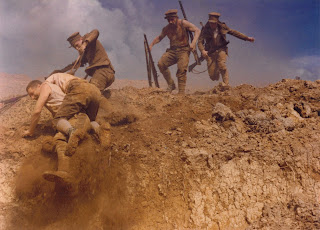
This photograph from the Auckland Weekly News Supplement (AWNS) depicts first aid being applied to an ANZAC soldier on the sloping terrain of Gaba Tepe on the Gallipoli Peninsula on 25 April , 1915. Published on 24 June 1 915, one hundred years ago today, it is considered the first newspaper image of the Gallipoli campaign and is attributed to Private Robert Blackwood Steele  of the Auckland Infantry Battalion . Ref: R.B. Steele for the Auckland Weekly News, New Zealanders in action, 24 June 1915, Sir George Grey Special Collections, Auckland Libraries, AWNS-19150624-35-1. 

Auckland Libraries’ war memorial libraries

Image
At least nine of Auckland Libraries’ past or present community libraries are either war memorial buildings or have war memorial associations. The oldest of these is the Albany Memorial Library . On Peace Day 19 July 1919 a group of Albany residents resolved to build a library as their district’s war memorial. Architect Sholto Smith designed the building. Governor-General Lord Jellicoe opened the cottage-style, half-timbered structure on 21 December 1922. The library was approached via a stone arch with ‘1914-1918’ inscribed on the keystone. The words ‘Albany Memorial Library’ were displayed above the entrance. The east window commemorated the Great War. Inside, a brick fireplace incorporated a green marble memorial tablet listing the names of 23 local men who gave their lives during the First World War. (Another tablet was later added honouring seven dead from the Second World War.) The building functioned as a working library until 2004, and is still available for commun...

Mauku Victory Hall

Image
There is an interesting and rather beautiful little hall in Union Road, Mauku (a semi-rural locality between Waiuku and Pukekohe). Known as the Mauku Victory Hall, this was formally opened by Governor-General Viscount Jellicoe on 7 June 1922. Ref: Bruce Ringer, Mauku Victory Hall, August 2014.

The Lusitania and Submarine Warfare

Image
By 1915 the Auckland Weekly News Supplement was becoming a sophisticated propaganda organ. Editorial policies determined what readers would see and how they would interpret photographs, in a campaign to make them accept the need to win this ‘Great War for civilisation’ against a barbaric enemy. They were led to believe this was so even if it must be fought at the great human cost shown each week in the Weekly News Roll of Honour. As casualties on the Gallipoli Peninsula began to mount, photo editors inserted reminders in the magazine showing readers just why we were fighting this war. They often did this by repeating photos and drawings about the Horrible Hun’s new and ungentlemanly ‘total war’ against civilians (especially women and children) through the evil menace of submarines lurking underwater to wreak death and destruction on the high seas. In February 1915 the Germans declared the waters around the British Isles a war zone where all Allied and neutral vessels risked being sun...

The first five men

Image
On Sunday afternoon 26 April five armed and mounted men clattered down the main street of Waiuku. Ref: Bruce Ringer, Outside the Kentish Hotel, Waiuku, 2015. The occasion was not a bank robbery nor a gymkhana but a reenactment, 101 years after the event, of a locally famous photograph taken of the first volunteers to leave Waiuku for active service during the First World War. Ref: Volunteers, Waiuku, August 1914, photograph reproduced courtesy of Waiuku Museum Society, South Auckland Research Centre, Auckland Libraries, Footprints 04686. These five men posed on their horses outside the Kentish Hotel on 17 August 1914. Captain John Henry Herrold of the Waikato Mounted Rifles is on the far left. He is accompanied by, from left to right, Troopers Frank Knight , Robert William ('Bob') Hammond , Alexander Glass and Henry Eisenhut . If you would like to add to the records of these first five men, you can do so at the Online Cenotaph website or keep an eye out for ...

Onehunga soldiers’ roll of honour

Image
What must be one of New Zealand’s finest and most elaborate First World War rolls of honour is found upstairs at the Onehunga RSA , 57 Princes Street, Onehunga. Sir F.W. Lang MP unveiled the Onehunga soldiers’ roll of honour in the town’s Carnegie Library on 25 April 1919.  Ref: James D Richardson, Carnegie Library, Onehunga, 1915, Sir George Grey Special Collections, Auckland Libraries, 4-1476.

News from the Dardanelles

Image
On 29 April 1915 Prime Minister Massey announced in Wellington that four days earlier New Zealand troops had participated in the landings on the Gallipoli Peninsula in the Dardanelles. However actual photographs of military activities and living conditions at Gallipoli were sparse in the Auckland Weekly News Supplement until late July 1915. There were photographs of the naval warships trying to force a passage through the Dardanelles and bombarding the Turkish forts there. There was also the Roll of Honour; and its seemingly never-ending portraits of casualties must have alerted readers that something BIG was happening. But either distance, censorship, early lack of official photographers or the simple fact that the troops  couldn't  easily get their films developed meant the  Auckland Weekly News could only gradually reveal the campaign to its readers as events unfolded. This little piece might shed some light on how Auckland Weekly News readers learned about life an...

Maps of Gallipoli

Image
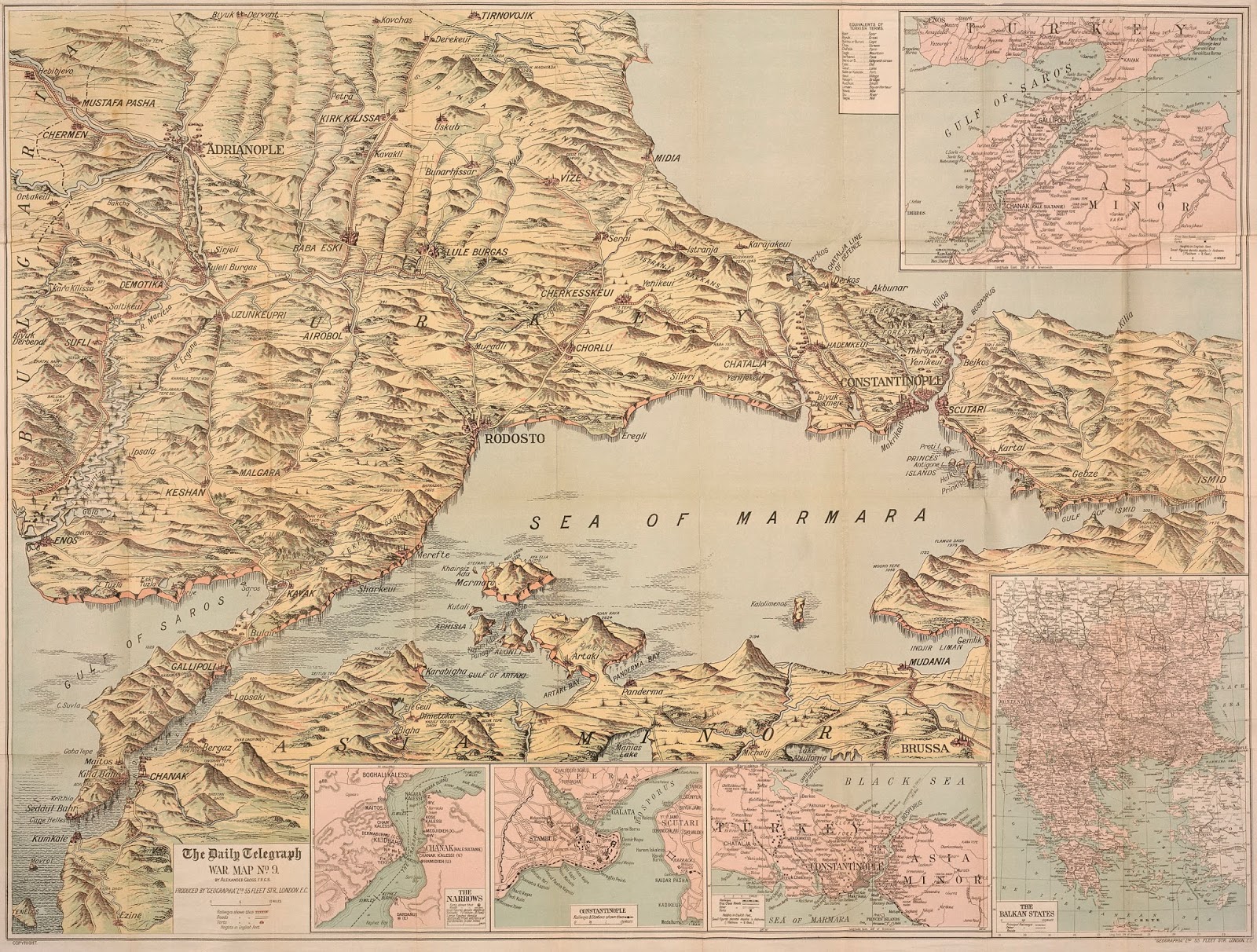
Sir George Grey Special Collections hold a number of First World War maps of Gallipoli and surrounding regions. Seven of these maps have been digitised and are accessible via the Heritage Images database. In April 1915, New Zealand soldiers, alongside those from Australia, Britain and France, invaded the Gallipoli Peninsula. This was to ensure an Allied naval force could break through the Dardanelles Strait and seize or threaten the Ottoman capital of Constantinople, and hopefully the Ottoman Empire might be forced out of the war. The British landed at Cape Helles on the southern tip of the peninsula, while the Australian and New Zealand Army Corps (ANZACs) landed half way up the peninsula, in order to cut off the Ottomans’ supply route to the south. Neither force managed to achieve their primary objectives and the conflict soon turned into a stalemate of trench warfare. Ref:  The Daily Telegraph picture map of the Dardanelles... , 1915, Sir George Grey Special C...