Posts

Showing posts with the label book trade

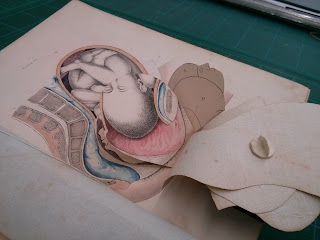
Obstetric tables: a 19th century flap book
Image
In 1845 George Spratt published the fourth edition of his highly successful Obstetric tables : comprising graphic illustrations, with descriptions and practical remarks; exhibiting on dissected plates, many important subjects in midwifery . This illustrated anatomical ‘flap book’ is a recent addition to the Sir George Grey Special Collections printed collection. You can view a digitised version of the 1835 edition through the Internet Archive, or come visit us on Level 2 of the Central City Library to turn the pages (and lift the flaps) yourself. Obstetric tables was published as a training aid at a time when it was becoming difficult for medical students to gain clinical experience. It contains a large number of layered illustrations that can be lifted to provide ‘dissected’ views of the female body in pregnancy. Some of the plates contain as many as four or five layers, showing for example the different stages of pregnancy, the position of a baby during birth, and use of forceps ...

Bernard & Picart's Ceremonies: the book that changed Europe

Image
The ceremonies and religious customs of the various nations of the known world was the first book to compare the world’s religions in a way that encouraged tolerance and has recently been called ' The book that changed Europe'. Listen to Sue Berman and Andrew Henry discuss the book on our Real Gold podcast . The ceremonies and religious customs was illustrated by Bernard Picart and written and published in Amsterdam by Jean Frederic Bernard between 1723 and 1737. Better known as Picart’s Ceremonies it is a beautifully illustrated seven volume work with over 260 plates of engravings by Picart who was one of the most famous engravers and book-illustrators of the time. Much of the text that accompanies these images was written by Jean Frederic Bernard, a successful book publisher, although his name never appeared on any of the editions. What made this such a revolutionary work was that Bernard & Picart try to present as positive a version of other beliefs to th...