Posts

Showing posts with the label medicine

Medical marijuana in colonial New Zealand

Image
There was a time when New Zealanders could buy marijuana over the counter for ailments ranging from asthma to corn removal. In the 1880s cannabis or hemp, as it was known then, only cost a shilling an ounce. Mother Aubert used cannabis as a tea for nun’s menstrual cramps at her mission in Jerusalem on the Whanganui River. Brett’s Colonists’ Guide endorsed Indian hemp as a treatment for painful menstruation, too - in a concoction including camphor and opium. Ref: New Zealand Graphic, In the dispensary, 22 September 1906, Sir George Grey Special Collections, Auckland Libraries, NZG-19060922-6-2.
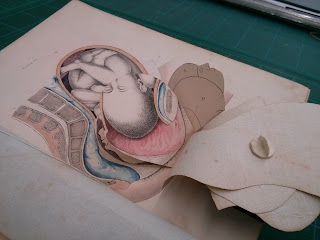
Obstetric tables: a 19th century flap book

Image
In 1845 George Spratt published the fourth edition of his highly successful Obstetric tables : comprising graphic illustrations, with descriptions and practical remarks; exhibiting on dissected plates, many important subjects in midwifery . This illustrated anatomical ‘flap book’ is a recent addition to the Sir George Grey Special Collections printed collection. You can view a digitised version of the 1835 edition through the Internet Archive, or come visit us on Level 2 of the Central City Library to turn the pages (and lift the flaps) yourself. Obstetric tables was published as a training aid at a time when it was becoming difficult for medical students to gain clinical experience. It contains a large number of layered illustrations that can be lifted to provide ‘dissected’ views of the female body in pregnancy. Some of the plates contain as many as four or five layers, showing for example the different stages of pregnancy, the position of a baby during birth, and use of forceps ...

The Golden Age of Purgation

Image
Constipation was an obsession in the early 20th century. It was thought to pollute the blood and in turn cause everything from bad breath to liver failure, madness or syphilis. In books such as “The Conquest of Constipation” doctors warned that the contents of the colon created “sewer-like blood” leading to 90 percent of disease. Ref: AWNS-19220615-35-5, Sir George Grey Special Collections “How can I emphasise enough the importance of bowels in those days?” wrote New Zealand author Ruth Park. As a child in Te Kuiti she was forced to drink castor oil every day. “It was given to me in orange juice on the top of which it floated in a viscid greenish layer. I wanted to throw up before I drank it.”