Posts

Showing posts with the label photograph

The Ways We Remember
Image
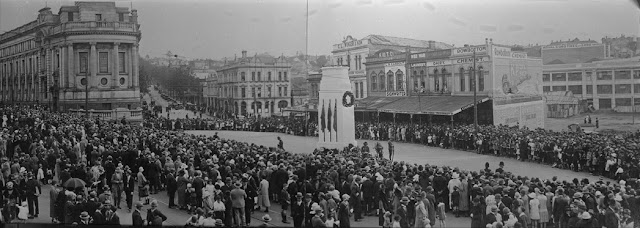
Contrary to our current state of national lockdown, it does take a lot to cause a society to come to a standstill. Yet, each year on 25 April many New Zealanders embrace an early rise on a cold morning to attend an Anzac service. Bursting with tradition, symbolism, emotion and ritual, Anzac services have been a key part of our national calendar since the first service in 1916. This year marks the first year that Anzac Day will not be commemorated with any large public events and so I thought I would delve into our online databases Kura and Heritage Images to take a trip down memory lane and look at the different, and sometimes uniquely Kiwi, ways in which we have commemorated Anzac Day over the past 104 years. Unknown, Anzac Day Town Hall, 1920s. Auckland Libraries Heritage Collections, 7-A9270 News of Allied troops landing on the beaches of the far-flung Gallipoli Peninsula reached New Zealand in the days following the now infamous maneuvers of 25 April, 1915. NZ History d...

First photograph from Gallipoli

Image
This photograph from the Auckland Weekly News Supplement (AWNS) depicts first aid being applied to an ANZAC soldier on the sloping terrain of Gaba Tepe on the Gallipoli Peninsula on 25 April , 1915. Published on 24 June 1 915, one hundred years ago today, it is considered the first newspaper image of the Gallipoli campaign and is attributed to Private Robert Blackwood Steele  of the Auckland Infantry Battalion . Ref: R.B. Steele for the Auckland Weekly News, New Zealanders in action, 24 June 1915, Sir George Grey Special Collections, Auckland Libraries, AWNS-19150624-35-1. 

Clifton Firth

Image
During the mid twentieth century, there was no NZ photographer more versatile, imaginative and accomplished than Reginald Clifton Firth (1904-1980). Yet he fell into photography by fluke. Ref: 34-M7B3 woman modelling a hat for Milne and Choyce department store, c. 1940-50s, Sir George Grey Special Collections When he was young, he he trained as a graphic designer at the Elam School of Art in Auckland. In the late 1920s and early 1930s he made a living as a commercial artist. By chance, a client asked for photographs of company products rather than drawings. Firth bought a camera for £4 from an Auckland shop in anticipation of the job. However, knowing little about photography and feeling concerned that he wouldn't do a good job and lose hard earned cash, he asked the shopkeeper for a money-back guarantee. He needn't have worried since the client  was delighted by the results. This changed Firth's career path forever.