Posts

Showing posts with the label women's rights

Fifty year wait for the loo

Image
Auckland’s first Council-funded toilet was built for men on Queen Street wharf in 1863. However, the first Council-funded women’s facilities did not open until 1915 - after women’s groups and the district health officer had spent many years agitating for them. Prior to the Wyndham Street loos opening, women relied on toilets at the public library, railway station, ferry company and stores – who lavishly advertised these sought-after conveniences. The Strand Café offered “ beautifully fitted ladies’ lavatories ”, and Smith and Caughey “cordially invited” ladies “ to make free use of our up-to-date writing and retiring rooms and lavatories .” Ref: Auckland City Council, Looking down Wyndham Street to Queen Street, 25 February 1964, Sir George Grey Special Collections, Auckland Libraries, 580-9610.

Arsons, marches and petitions: the 1970s abortion debate in New Zealand

Image
Creating New Zealand’s abortion law Abortion was illegal in NZ until the 1970s unless required to save the mother’s life. Nevertheless, the procedure was widely practiced and often unsafe. In 1927 a Department of Health official estimated 10,000 abortions took place annually - with NZ having one of the world’s highest death rates from botched abortions. This prompted the government to set up a Committee of Inquiry in 1936. Instead of focusing on the high rate of maternal deaths, the Committee focused on the falling birth rate and recommended an increase in family allowances.  A 1939 British ruling influenced the interpretation of abortion law in NZ to include mental health as grounds for the procedure, but many doctors refused to perform abortions. Ref: Alan Brown, Abortion march, 28 July 1972, Broadsheet Collective Records, Sir George Grey Special Collections, Auckland Libraries, NZMS 596.

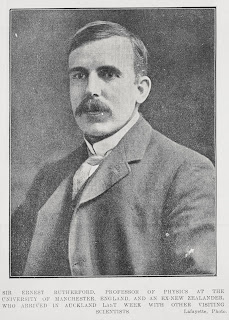
Sir Ernest Rutherford

Image
It was sixty-six years ago this month that Nobel prize winner Ernest (Ern) Rutherford  (1871-1937), the "father of nucelar physics" passed away. He was interred in Westminster Abbey, surrounded by the ashes of scientists such as Sir Isaac Newton. Rutherford was 66 when he died.  Following his death an obituary in the New York Times said, "It is given to but few men to achieve immortality, still less to achieve Olympian rank, during their own lifetime. Lord Rutherford achieved both.” Despite his intellectual achievements, Rutherford, or Ern as he was called, was said to be a humble man. Physically, he was large, and quite the talker. He had a tendency to spill his tea on his waistcoat, to which wife, Mary, would proclaim, “Ern, you’re dribbling.” Mary had marched with the suffragettes in London and not surprisingly, Ern was a huge supporter of women studying the sciences.  His very first research assistant, Harriet Brookes, assisted him in the discovery of rado...