Posts

Sir George Grey & Kawau Island
Image
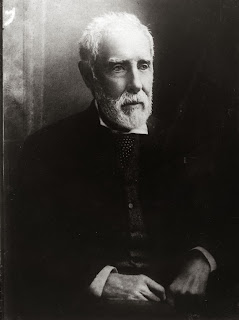
Politician, linguist, collector, soldier and explorer, Sir George Grey is an important figure in New Zealand history. He was the most influential of New Zealand’s governors, serving in the role from1845 -1853 and again in1861 - 1868. Grey started off as an army officer in Ireland before leading an exploring expedition in Western Australia in the late 1830s. His established himself as a very able colonial politician during his governorship of South Australia from 1840-1845. This helped him secure the position of Governor of New Zealand. Between his two terms in New Zealand he was also Governor of the Cape Colony in South Africa from 1854-1861. Ref: 4-1341, portrait of Sir George Grey, c.1812-1898, Sir George Grey Special Collections Despite his successes, he is seen by some as a controversial figure. Historian James Belich called him "a strange, complicated man, whose real charisma and genius almost matched his flaws”. He was however a great benefactor to the Auckland Fr...
Robert Burns

Image
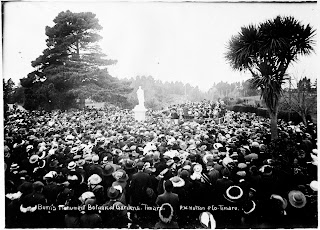
Three long lost Robert Burns (1759-1796) manuscripts including letters from the well loved Scottish poet and his friends were discovered earlier this year. Chris Rollie, a researcher discovered the manuscripts inside an Extra Illustrated W. Scott Douglas edition of 'The Works of Robert Burns', from 1877-79. This edition belonged to Burns's publisher, William Paterson. Ref: 35-R1480, unveiling of the Robert Burns statue in Timaru Botanical Gardens, no date, Sir George Grey Special Collection One of the discovered letters is from 'Clarinda' the pseudomny for Agnes McLehose. Burns was in love with Agnes and she was the subject of several of his poems including: ' Clarinda (Mistress of My Soul ' and ' To Clarinda '. After Burns' death in 1796, Agnes had requested that the intimate letters she had written to Burns be returned to her by Burns' friend and doctor William Maxwell.

South Auckland's special constables

Image
October 2013 is the centenary of the Great Strike, a wave of industrial unrest that affected the whole of New Zealand. The strike - or lockout - began on the Wellington wharves on 22 October 1913. By 28 October the trouble had spread to Auckland. Ref: 7-A10659, showing rioters in Featherston Street, Wellington running for protection from Mounted Special Constables during the Waterside Strike, 1913, Sir George Grey Special Collection s The Reform government under Prime Minister William Ferguson Massey had proposed the use of the military to occupy the wharves, maintain essential services and protect strike-breakers, but ultimately decided to use civilian 'special constables' instead. In the Auckland area, enrolment of special constables began on 29 October. The New Zealand Farmers' Union - concerned with keeping the wharves free and export trade moving - actively sought out volunteers in rural districts. Ref: AWNS-18991215-5-9, WF Massey, Parliamentary Representati...

'Our boys, our families' research guide

Image
As part of the build up to the First World War centenary commemorations within NZ and around the world, Auckland Libraries, Auckland Council Heritage Unit and Auckland Council Archives have developed an A5 research guide. 'Our boys, our families' outlines the First World War resources available at Auckland Libraries and Auckland Council Archives . This includes: Rolls of Honour, cemetery records, memorials, books and photographs from the Schmidt Collection and supplement to the Auckland Weekly News. Ref: 7-A14534, a family receiving the result of the ballot for Class B reservists under the NZ Military Service Act, 1918, Sir George Grey Special Collections The research guide is intended to assist you with your own research into family members or people who took part in the war. This could be a soldier on the front line, a nurse on a hospital ship or a person on the home front including conscientious objectors. There are a selection of handy research prompts tucked into t...

The Art of Private Press books.

Image
In one part of the printed book collection of Sir George Grey Special Collections there is a section of books grouped by Private Press publisher name. Private Press books can be defined as books printed by hand, in limited editions, with as much emphasis on making an object of beauty as on reproducing a text. Private Press books are excellent sources of inspiration for artists and can be appreciated by anyone who admires carefully crafted things. Examples of books from some of the many Private Press publishers featured in the collection include exquisite first editions from Arts and Crafts era printers the Doves Press and Kelmscott Press, intricate book art from Flying Fish Press  and The Whittington Press , and a wide range of lovely books from New Zealand printers like The Holloway Press , Otakou Press ,  Puriri Press  and The Pear Tree Press. Alongside these fine books are journals that promote, review and critique the work of Private Presses and related in...

Niuean Language Week

Image
Fakaalofa lahi atu. Niue Language Week runs this year from 13 to 19 October. The theme is 'Leveki mo e fakaaoga e Vagahau Niue – Treasure and use the Niue Language'. Did you know that Niueans represent our fourth-largest Pacific group in New Zealand? So it seems highly appropriate to celebrate the Niuean culture and language during this week. The language week has been organised largely by the Vagahau Niue Trust and Matakau Pulefakamotu Niue Okalana, with support from the Ministry of Pacific Island Affairs. Check out the ministry's Facebook page for more information and the programme to find out what is happening near you. Enjoy the selection of  heritage photos below, which are drawn from the heritage collections at Auckland Libraries, to celebrate Niue Language Week. Niuean royalty: Ref: AWNS-19001005-3-3, the King and Queen of Niue with the NZ Premier and Mrs Seddon, Niue, 1900, Sir George Grey Special Collections

Tree planting as a form of commemoration

Image
Plaques, benches, statues, arches, stained glass window panes and many other things are commonly used to commemorate events (e.g. coronation of King Edward VIII), celebrate certain days (e.g. Arbour Day ) or to remember people who have passed away (e.g. soldiers who fell during a war). Tree planting is another way of marking and creating significance at these occasions and beyond. From digging the hole, the planting event itself to the ceremony, these stages can be viewed through the photographs drawn from the heritage collections at Auckland Libraries. Digging the hole: Ref: AWNS-19360527-50-5, tree planting ceremony, 1936, Sir George Grey Special Collections Digging the tree in: Ref: AWNS-19370519-55-3, tree planting ceremony in Invercargill, 1937, Sir George Grey Special Collections