Posts

Te Wiki o Te Reo Māori: Pūtahitanga exhibition

Image
To mark  Te Wiki o Te Reo Māori , Māori Language Week, for 2015 here at Heritage et AL we are featuring some of the oldest items in our collections relating to te reo Māori. These taonga are all held in Sir George Grey Special Collections and currently on show in our exhibition space on the second floor of the Central Library as part of our exhibition   Pūtahitanga: a meeting of two worlds in the North, 1769-1842 . The arrival of Captain James Cook in New Zealand in 1769 is usually seen as the beginning of the meeting of two worlds – the Māori and the European – leading to increasing interaction, misunderstanding and understanding, cross-cultural movement and exchange. This exhibition reveals some of those interactions with explorers, sealers and whalers, missionaries, traders and settlers in the documents and books produced at the time and held in Sir George Grey Special Collections. The word Pūtahitanga means a confluence of streams and expresses the fluidity ...

New family history videos online

Image
We've had a sudden release of family history videos published to our YouTube channel - packed full of loads of tips! New online: Colleen Fitzpatrick: The "Unknown Child" of the Titanic - identified? 20 April 2015 Of the 328 bodies recovered by the salvage operation of the SS Titanic, just one was that of a child. His identity was unknown for nearly a century until 2002, when Dr. Alan Ruffman and Dr. Ryan Parr announced that they had identified the remains of the "Unknown Child". But was this identification correct? Hear how we resolved the controversy so that the Unknown Child of the Titanic was unknown no longer. Exploring Online Cenotaph with Victoria Passau 15 April 2015 New Zealanders have served this country in many international conflicts. Online Cenotaph, created by Auckland War Memorial Museum, aims to commemorate the stories of these veterans. This session showcases the new Online Cenotaph and discusses how family members and private r...

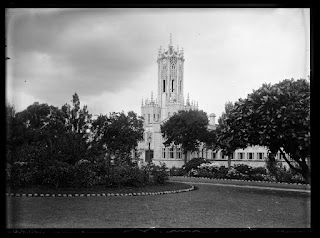
University of Auckland: Clock Tower and Old Choral Hall

Image
While exploring Heritage Images online I decided to search images of the University of Auckland out of interest as I’ve studying there for the past five years. The images are very interesting and give a gauge as to how the university has changed over the years. Ref: Henry Winkelmann, Looking across Princes Street from the Albert Park grounds..., February 1927, Sir George Grey Special Collections, Auckland Libraries, 1-W791.

Māori Land Court Minute Books - Part 1

Image
Image: North Auckland's Native Lands: Maoris attending the Land Court at Ahipara (1904) Sir George Grey Special Collections, Auckland Libraries, AWNS-19041027-11-1 The Māori Land Court minute books are a very important resource for whakapapa research. They are also valuable for local history, early Māori history, and Waitangi Tribunal research. " Whakapapa literally means the ‘laying down of generations’ layer upon layer. Whakapapa is about people, it is a link to tūpuna, to heritage, to identity. For Māori it is a taonga, and for many it is also tapu. Traditionally whakapapa was handed down orally to a member of the whānau deemed appropriate to look after the whānau whakapapa ." (Paewai, 2015, p2). The Native Land Court (renamed Māori Land Court in 1947) was established in 1865 with the purpose of translating customary Māori land ownership into legal land titles recognisable under English Law. Traditional Māori land rights involved communal ownership ...

Eating in & dining out: Dalmatian-run grill rooms of the 1940s

Image
The 1940s were boom times for Auckland’s Dalmatian-run grill room restaurants, especially after US soldiers, sailors and nurses arrived in June 1942 - there were six grill rooms on Victoria Street West alone (Clarich, Jelich, Kosovitch, Lipanovich, Makovina and Urlich) and a further 20 in the central city. The Americans came for R and R after fighting in the Pacific, for medical attention, and for training. For the next two years about 50,000 American servicemen and women were in the country at any one time. They were often paid twice as much as local wages, and had three out of every four days free. Ref: Auckland Weekly News, US troops in Queen Street, 1942, Sir George Grey Special Collections, Auckland Libraries, 7-A14390.

A map of the Duke's Forest from 1567

Image
The map below is one of many beautiful and intricate hand-coloured illustrations and maps in Lodovico Guicciardini's book  on the Low Countries.  Sir George Grey Special Collection 's copy is a French edition published in Antwerp in 1567. It was donated to the library by Henry Shaw. The map is of Bolduch ('s-Hertogenbosch or the Duke's Forest) in the southern Netherlands. Iain Sharp notes in  Real Gold  that Guicciardini's book was one of the best sellers of the sixteenth century. Image ref: Map from: Lodovico Guicciardini.  Description de tovt le Païs-Bas, avtrement dict la Germanie inferievre, ov, Basse-Allemaigne. Antwerp: Guillaume Silvius, 1567. Sir George Grey Special Collections, Auckland Libraries, 7-C1964. The two main methods for printing maps in the sixteenth century were relief (usually woodcut) and intaglio (copper engraving or etching). The map pictured is a copperplate engraving. The intaglio technique involves engraving l...

Remembering the Rainbow Warrior

Image
On the weekend of 25 and 26 July the Greenpeace flagship Rainbow Warrior III will be moored at Princes Wharf, Auckland. Its visit commemorates the thirtieth anniversary of the sinking of its predecessor at Marsden wharf on 10 July 1985 by agents of the French security intelligence service. Greenpeace photographer Fernando Pereira drowned on the sinking ship. The day after the act of sabotage Alton Francis snapped a shot of the half-submerged Rainbow Warrior .  Ref: Alton Francis, Rainbow Warrior, July 1985, South Auckland Research Centre, Auckland Libraries, Footprints 02431.