Posts

Gorgeous Girl Shows

Image
For a brief time in the 1940s Auckland dancers performed Gorgeous Girl Shows wearing little more than G-strings, balloons and fans, to packed houses of appreciative American servicemen. Image: The Pony Dancers. From: The New Zealand Herald, 9 August 1975. Auckland Libraries Heritage Collections. Over half a million GI’s arrived in New Zealand for rest and recuperation between June 1942 and the end of WW2. They were keen to be entertained in the city’s nightclubs and dance halls and made a beeline for The Civic Theatre’s Hollywood-style floor shows. The theatre’s 3,000 tickets often sold out within an hour. Patrons watched the latest movie then the Civic’s golden barge rose from the depths bearing an orchestra, dancing girls, and “star, Freda, in peacock-feathered headgear, posing as the stem of a huge champagne flute.” Image: Clifton Firth. Freda Stark, 1947. Auckland Libraries Heritage Collections, 34-409. Freda Stark became an overnight sensation after a costume malfunc...
Heartfelt thanks from the mother and father of an HMS Orpheus survivor

Image
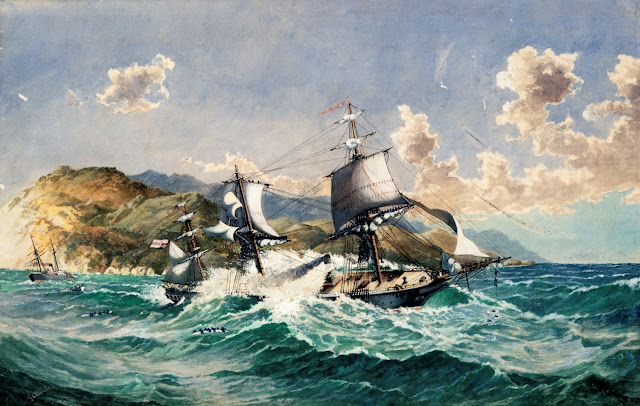
The painting below features in a slideshow which is part of the Gatherings on the Manukau Exhibition. This travelling exhibition opened at the Waiuku Library on 17 October 2017, closing on 4 November 2017. Image: G.C. Beale, HMS Orpheus wrecked in the Manukau Harbour, February 1863. Auckland Libraries Heritage Collections, 7-C6. In terms of lives lost, it still ranks as New Zealand’s worst maritime disaster. On 7 February 1863 the Royal Navy corvette HMS Orpheus had difficulty entering the Manukau Harbour in stormy weather, struck a sandbar near Whatipu Beach and rapidly began to sink. Part of the Australia Squadron, the corvette was delivering reinforcements and supplies to assist British troops and settler volunteers in the Waikato War. There were 259 men on board. In the attempt to abandon ship many were dashed to their deaths in the sea’s powerful surge. The coastal steamer Wonga Wonga was in the harbour at the time and came to the aid of men struggling in the wav...

William Eastwood (1821-1877) and his Manukau watercolours

Image
We can trace the footsteps of local artist William Eastwood as he journeyed about the Manukau Harbour from 1866 to 1876. His wonderful watercolour paintings reveal various aspects of the landscape around the harbour during this decade. The tones and washes of colour reflected across the paintings are still present in the harbour today. Born in London, England, Eastwood, his wife and their eight children immigrated to New Zealand, arriving in February 1863. Upon arrival he worked as a conveyancing clerk for law firms. Soon after arriving he joined the Mechanics Institute. He was one of the founders of the Society of Artists, Auckland and held the position of President. In 1875 he served as Chairman of the Onehunga Highway Board. William later inherited money from the estate of a wealthy relative in England, allowing him, from his base in Onehunga, to travel about New Zealand and to Australia. During these travels he painted and sketched many landscape scenes. Image: William Eastwo...

Passchendaele, Dave Gallaher and the All Blacks

Image
As part of the ongoing centennial commemorations for the First World War, this week marks the centenary of the Battle of Passchendaele . It was during this battle that one of the most famous New Zealanders of the day, the ex-All Black captain, Dave Gallaher was killed. Image: Portrait of Dave Gallaher. From: The king and his navy & army. A weekly illustrated journal for society, the salon and the services. 1905. Auckland Libraries Heritage Collections. The centenary of Passchendaele and Gallaher’s death seem an appropriate time to reflect on how his 1905 All Black team were viewed in Britain.  A colleague recently alerted me to the existence of the publication, Navy & army illustrated : A magazine illustrative of everyday life in the defensive services of the British Empire . Tracking Gallaher’s 1905 Originals tour through this weekly British Armed Forces publication we can see the mystique that Gallaher and his team created as well as the legacy they left. On...

Presbyterianism on the peninsula

Image
On the last Sunday in September the Awhitu Central Church will celebrate its 140th anniversary. Travellers who pass through Awhitu Central on their way to the Manukau Heads lighthouse will be familiar with this iconic building.   Ref: Bruce Ringer, Awhitu Central Church, 20 August 2017.     The Awhitu Central Church was opened as the Awhitu Presbyterian Church on 23 September 1877 (in accordance with the wishes of the donor of the land, George Garland, it also accommodated both Anglican and Methodist congregations). It is today the last active church of four Presbyterian churches which were opened on the Manukau Peninsula during the 19th century, although two other equally picturesque buildings survive. When the Awhitu church opened there were already two Presbyterian churches in the nearby Pollok settlement. One had been opened by members of the Scotch Presbyterian Church on 22 May 1870, the other by members of the Church of Scotland on 14 June 1870. The fo...

Gatherings on the Manukau exhibition

Image
The Manukau Harbour is the second largest in Aotearoa. Loved and enjoyed by many, Te Manukanuka o Houturoa has always been a source for food gathering and has long provided the means for navigating the expansive coastline. Photographs from the Auckland Libraries heritage collections form the basis of this exhibition which is on now at Te Uru Waitakere Contemporary Gallery in Titirangi, Auckland. Ref: John Thomas Diamond, The shoreline on the Cornwallis Peninsula with John Diamond rod fishing, 1957. Auckland Libraries Heritage Collections, JTD-08E-00513-2 This exhibition will travel around the edges of the Manukau Harbour as if spread by Te Hau a Uru, the wind that blows from the west, from Titirangi to Waiuku. 7-28 September 2017: Te Uru Waitakere Contemporary Gallery, Titirangi. 30 September-14 October 2017: Nathan Homestead, Manurewa. 17 October-4 November 2017: Waiuku Library, Waiuku. Ref: James Richardson, Stereograph of the Nihotupu Creek, 14 April 1923. Auckland L...

The Going West archive - Out of the box

Image
In looking back over 22 years at the creation of the Going West Books & Writers Festival archive, it would be great to be able to say that it was a well-planned exercise, deliberately designed to create a record of the best, and sometimes eccentric, voices of our writers and thinkers. This is unfortunately not the case. The very existence of the archive was more, in the first year, a matter of serendipity and happenstance. The very notion of a New Zealand writers festival out west, referencing Maurice Gee's novel Going West , was the brainchild of book seller and history lover, Murray Gray – with some substantial support from Mayor Bob Harvey. For 10 years it included a steam train adventure replicating the voyage captured by Maurice in his book and starring luminaries of the literary world. Just once we enticed Maurice up to the west and he read from Going Wes t on the Henderson Rail Platform. What a moment that was! Image: Maurice Gee reads at the Henderson Railway Stat...