Posts

Doctor’s Houses, 25-29 Symonds Street, Auckland Central

Image
It’s Auckland Heritage Festival from 26 September to 11 October 2020. During the Festival we will share some hidden histories about Auckland places written by Auckland Council Heritage Unit staff. Marguerite Hill is the Heritage Researcher in council’s Heritage Unit and has an interest in health history. There are about 2500 places in the Auckland region which are scheduled as historic heritage places. Quite a few of these places are associated with medicine and health and several of those places are on Symonds Street. Symonds Street was a popular spot with medical practitioners due to its proximity to Auckland Hospital. You might walk past this building every morning or pop in there for your lunch, but did you know the history of the Doctors’ Houses at 25-29 Symonds Street? Image: Marguerite Hill. Doctor’s Houses, 25-29 Symonds Street, 2019. Auckland Council Heritage Unit. These Neo-Jacobean terrace houses were built for John and Ellen Endean in about 1897. The architect and builder a...

The many lives of E. Mervyn Taylor’s mural Te Ika-a-Maui

Image
Te Ika-a-Maui in Takakpuna Library. The NZ Post Office commissioned Te Ika-a-Maui in 1961 as part of a nationwide celebration of the new Commonwealth Pacific Telephone Cable (COMPAC) - which was going to triple the country’s capacity for international calls. A cable terminal was built in Akoranga Drive, Northcote. Te Ika-a-Maui was installed in the foyer and open for the public to view. A COMPAC press release stated “Being in ceramic tile, the mural which is one of Mervyn Taylor’s outstanding works, will be assured of the permanency it undoubtedly deserves.” The mural appeared in newspapers around the country, and in the souvenir booklet Voices Through The Deep , which noted it was the focal point of the terminal’s entrance vestibule. E. Mervyn Taylor felt there was an analogy between the ‘fishing up’ of the North Island by Māui, and its modern counterpart, this new cable that would draw New Zealand out of the Pacific into the telephone systems of the world.  However, the permane...

The hula-hoop – coming full circle

Image
Who would have thought something like a simple plastic hoop could provide so much fun and have such an interesting history? Image: Rykenberg Photography. Home portrait: unidentified child, 1959. Auckland Libraries Heritage Collections 1269-K169-6   Did you know that the ancient Greeks were known to have used grapevine hoops as exercise equipment to tone up the waist? And as far back as 3000 BC, Egyptians commonly used materials such as reeds and rattan to work into circular shapes or hoops. They would roll the hoop along the ground with a stick, or throw it up in the air or rotate it around the waist - just as we do now. Image: Photographer unknown. Miss Westland and kindergarten children with a hoop from an Auckland Kindergarten Association photo album, 1931. Auckland Libraries Heritage Collections, NZMS 1275-14-4.      The hoop was used not only for fun, exercise and education, but also for religious and artistic purposes. The Lakota peop...

Early record of Auckland democracy

Image
The Auckland Library Heritage Trust has recently acquired a printed, annotated burgess roll for the City of Auckland for 1887 to 1888 that is believed to be unique. They have kindly lent it to Auckland Libraries where it is currently on display in the Heritage Collections reading room at Tāmaki Pātaka Kōrero, the Central City Library. Stamped ‘Mayor’s Office’ in gilt on the binding, the roll is preceded by a manuscript list of 32 alterations authorised by council between May 1887 and April 1888. In most instances these correspond to amendments in the six individual ward rolls within the volume. No copy of this roll is held by the National Library or the Alexander Turnbull Library in Wellington, nor by any other Auckland research library. Auckland Libraries, Council Archives and Auckland War Memorial Museum have the most comprehensive collections of rolls, though wards are missing for some years in what has survived. Council Archives’ rolls cover 1872 to 1899 (series ACC 396). Manu...

The saga of Boyd’s Zoo

Image
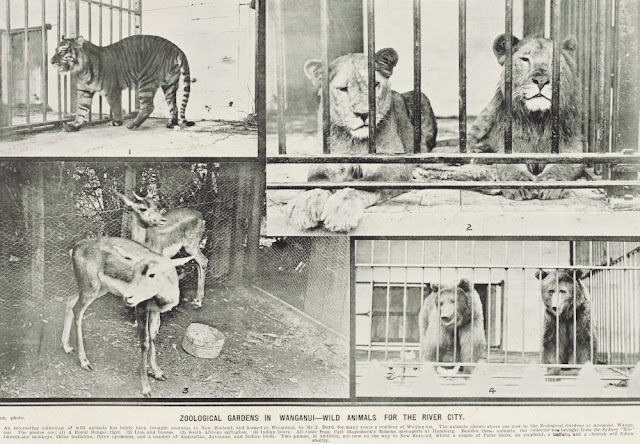
Boyd’s Zoological Gardens was a commercial enterprise established by John James Boyd in Upper Aramoho, Whanganui in 1909 after he had imported a lion and lioness, a tigress, and breeding pairs of bears and black buck antelopes, together with four macaws, two vultures and two demoiselle cranes from a zoo in Hamburg, Germany. The New Zealand Graphic published the following photo of some of his animals in the recently opened zoo in their issue on 9 February 1910: New Zealand Graphic. Zoological gardens in Wanganui, 1910. Auckland Libraries Heritage Collections, NZG-19100209-19-1 . Soon he must have expanded his menagerie because a photo published by the Graphic of 13 July 1910 includes an emu. This photo also shows his vultures: New Zealand Graphic. In the Wanganui zoo – an interesting collection, 1910. Auckland Libraries Heritage Collections, NZG-19100713-23-1 . However Upper Aramoho did not prove to be a good location, with poor attendances at Boyd’s zoo. Early next year...

Snow in Northland

Image
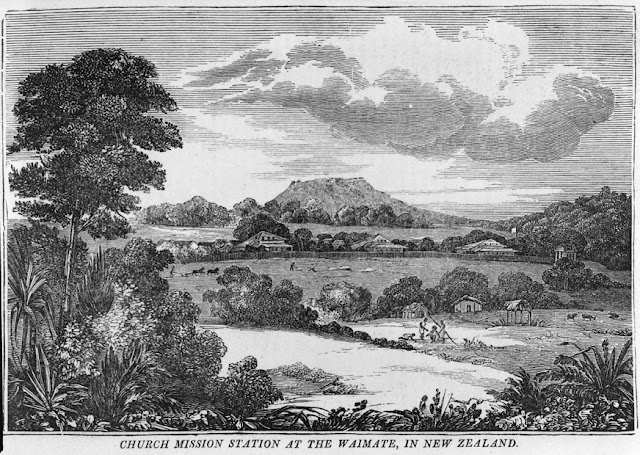
On 30 July 1849, Richard Davis, an Anglican missionary in the Bay of Islands, made this surprising entry in his daily weather diary : “Hail storms. This morning the southern hills and Poutahi covered with snow.” The next day, he noted that the hills were “again covered with snow.” The Davis family - Richard and Mary and their children - lived at the Church Missionary Society’s station at Waimate North, inland from Paihia, and the snow he referred to had just fallen on the hills behind the small mission settlement. It wasn’t the only extreme weather he would record in the nine years he documented Northland’s climate, but it was probably the most unexpected. Image: James Richardson. An engraving from the Missionary Register showing the mission station at Waimate with Bishop Selwyn's house, left of centre. Auckland Libraries Heritage Collections, 4-1274.  There are two weather registers by Richard Davis in Special Collections at the Central City Library, and together...