Posts

Showing posts with the label Sir George Grey

Addresses to Sir George Grey

Image
The Addresses to Sir George Grey is a large bound volume of over 300 pages, held in the manuscripts collection at Auckland Libraries. Conceived as a birthday tribute to Grey, the Addresses went from proposal to bound volume, with over 13,000 signatures, in less than a month. A first public meeting was held on Monday, the 15th of March, 1886: “ ... to take into consideration the propriety of Presenting a Congratulatory Address to Sir George Grey on his next Birthday, April 14 ”. New Zealand Herald , 15 March 1886 . Detailed reports in the newspapers over the course of that month included telling details: it is to be “ purely non-political, and has its sole raison d’être in admiration and respect for Sir George ” ( Auckland Star,  15 March 1886 )  – a pertinent point, given that Sir George Grey was a still a divisive force in the politics of the day and would have undoubtedly been reading the reports with interest. The article ends with the note “ It was also agreed that ...

The great war for New Zealand, Waikato 1800-2000 / Vincent O’Malley

Image
Ref: Vincent O'Malley. The great war for New Zealand, Waikato 1800-2000,  Bridget Williams Books, 2016, Auckland Libraries, 993.3 OMAL. On 12 July 1863 British Imperial Army troops crossed the Mangatāwhiri River which marked the boundary between British occupied territory and land under the authority of the Kingitanga (the Māori King movement). The crossing of this boundary by military troops, just south of the city of Auckland, was a declaration of war. The invasion of the Waikato had begun. Ref: Sketch map of the North Island of New Zealand, shewing approximately the loyal and rebel districts, 1869, Auckland Libraries Heritage Collections, Map 2563a.   Vincent O’Malley’s latest work The great war for New Zealand: Waikato 1800-2000 provides a vast repository of research to support his view that the Waikato war, the epicentre of the New Zealand land wars, was the defining conflict in the history of Aotearoa New Zealand. He believes that the war had a greater imp...

Parihaka

Image
Background After the signing of  Te Tiriti o Waitangi – The Treaty of Waitangi in 1840 the European population of Aotearoa New Zealand began to increase rapidly. Settlers wanted land. From early on, the area around Mt Taranaki had been identified as ideal land for British settlement. The New Zealand Company , an organisation which focused on colonisation and land sales, was involved in the settlement of New Plymouth and several extremely dubious land purchases in Taranaki in the late 1830s and early 1840s. New Zealand Company artist Charles Heaphy produced an enticing, idealised painting of Mt Egmont / Mt Taranaki to attract potential migrants. However, there was nothing to indicate that this was the ancestral tribal land of Te Ātiawa and other Taranaki Māori. When the new Colonial government was established, land purchase officers were officially appointed to purchase Māori land for the Crown, as outlined in the Treaty. Ref:  Heaphy, Charles, 1820-...

Julia Thorne George's wedding

Image
In today’s property market most young couples can only dream of such a wedding gift, but when Julia Thorne George married up-and-coming lawyer Wilfred Colbeck in June 1895 her parents presented her with a house in St Stephens Avenue, Parnell. What’s more, Sir George Grey sent her a generous cheque that enabled her to furnish the dining room in style. She was nevertheless miffed at Sir George for failing to attend the wedding. Technically, he was her great-uncle, but she regarded him more as a grandfather. She had lived in the same house as him most of her life. Her mother, Annie, was the daughter of Grey’s half-brother Godfrey Thomas, who died young. Grey not only took Annie in but continued to provide a home for her and her growing family after she married Seymour Thorne George in 1872. Ref: Daniel Mundy, I nterior of Mansion House, Kawau Island, c1870, Sir George Grey Special Collections, Auckland Libraries, 7-A3034.

Niuean language Bibles

Image
This week is E Faahi Tapu he Vagahau Niue 2015 , Niuean Language Week for 2015. As a result of Sir George Grey’s collecting of Pacific Islands language materials , Auckland Libraries has a collection of Niuean language Bibles. Today we’re going to look at three of our earliest publications in the Niuean language. The following descriptions are taken from the Historical catalogue of the printed editions of holy scripture in the library of theBritish and Foreign Bible Society compiled by T.H. Darlow and H.F. Moule. In the introduction to the catalogue T.H. Darlow writes that The British and Foreign Bible Society specifically exists to promote missionary versions of the scriptures. St Mark’s Gospel, published in 1861. Ref: Ko e evagelia ne tohi e Mareko, p.1, 1861, Sir George Grey Special Collections, Auckland Libraries, 226.3 KOEE.

Polynesian and Melanesian historical pamphlets

Image
This week marks Ni vosa Vaka-ITaukei ni vanua o Viti or Fiji Language Week for 2015. This is timely as we can happily share the news about some nineteenth century Fijian language items in Sir George Grey Special Collections that have recently been individually catalogued.  These Fijian language items were part of a larger collection of nineteenth century pamphlets in English, Polynesian and Melanesian languages collected by Sir George Grey . They include grammars, primers, vocabularies, and religious texts. The pamphlet shown below is an arithmetic textbook published in Levuka in 1865. Ref:  A vu ni vika vakaviti, p.1, 1865?, Sir George Grey Special Collections, Auckland Libraries, 372.72 AVUN.

New Year’s Festivities

Image
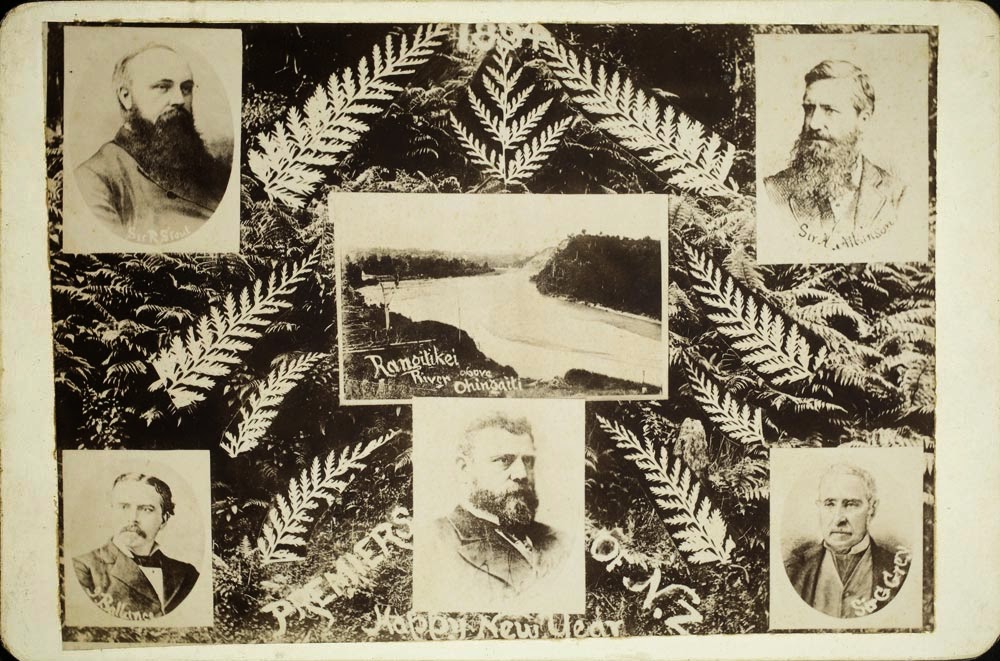
To see off the old year and help usher in the new we thought it would be appropriate to see how the New Year has been celebrated down the years: Ref: P.P. De Loree, Premiers of N.Z. Happy New Year, 1894, Sir George Grey Special Collections, Auckland Libraries, 661-67. Ref: Motor car invasion, Cockle Bay, 1939, 1 January 1939, South Auckland Research Centre, Auckland Libraries, Footprints 15.

Hydrographic heritage

Image
During the Auckland Tall Ships Festival  earlier this year the Auckland Libraries heritage and research collections  organised a popular display which included letters, maps, magazine covers and photographs. Of particular interest to many visitors were the hydrographic charts. These charts are fascinating examples of early mapping and are wonderfully detailed, with volcanic cones sometimes looking like puffs of smoke. They are accessible via the  Heritage Images  database and copies of the charts are available to be purchased from Sir George Grey Special Collections . Ref: NZ Map 3908a, Auckland Harbour, 1848-1855, Sir George Grey Special Collections Ref: NZ Map 2560, Kaipara Harbour, 1852, Sir George Grey Special Collections In 1848,  C aptain John Lort Stokes   commanded the paddle-steamer  Acheron, and began the first official hydrographic survey of the New Zealand coastline. Starting on Auckland's North Shore,...

Sir George Grey & Kawau Island

Image
Politician, linguist, collector, soldier and explorer, Sir George Grey is an important figure in New Zealand history. He was the most influential of New Zealand’s governors, serving in the role from1845 -1853 and again in1861 - 1868. Grey started off as an army officer in Ireland before leading an exploring expedition in Western Australia in the late 1830s. His established himself as a very able colonial politician during his governorship of South Australia from 1840-1845. This helped him secure the position of Governor of New Zealand. Between his two terms in New Zealand he was also Governor of the Cape Colony in South Africa from 1854-1861. Ref: 4-1341, portrait of Sir George Grey, c.1812-1898, Sir George Grey Special Collections Despite his successes, he is seen by some as a controversial figure. Historian James Belich called him "a strange, complicated man, whose real charisma and genius almost matched his flaws”. He was however a great benefactor to the Auckland Fr...

Dunedin City Library's manuscripts get a social media makeover

Image
Dunedin City Library's have put images of their  medieval manuscripts from the Alfred and Isabel Reed Collection onto Flickr. The old way of getting the word out meets the new! Find out more about this project. The images include a selection from each bound manuscript, and the front and back (or recto/verso if you want to use the fancy terminology) of each individual leaf and fragment. Images are divided into collections and sets . Ref: View of the Dunedin Public Libraries Medieval Manuscripts' photostream on Flickr  The site was created to promote and provide virtual access to one of New Zealand's largest collections of medieval manuscripts. One of the collection highlights includes a leaf and bifolium from a 9th century Bible in Carolingian script (RMMF 1a and 1b), which are among the oldest manuscript leaves in the country.

UNESCO Memory of the World

Image
Fancy going on a world tour of documentary heritage collections? Then read on ... The UNESCO Memory of the World project was launched ten years ago. It aims to recognise & create awareness, provide access and ultimately help contribute towards the preservation of culturally significant documentary heritage from around the world. Cultural institutions are encouraged to nominate material for the internationally recognised register . A look through the register reveals a wide array of items: illuminated manuscripts, archival records from significant companies, newspaper collections, photograph & film archives and even woodblocks. A wide range of languages, cultures, individuals, groups and events of significant social and cultural change are represented.