Posts

Showing posts with the label architecture

A Noble Site

Image
Image: Holy Trinity Cathedral as it appears today Holy Trinity Cathedral is a building familiar to most Aucklanders. Serving as the mother church of the Anglican Diocese of Auckland, it stands in a prominent position overlooking the city from the top of Parnell Road. It hosts a variety of events, spiritual and secular alike. Many Aucklanders who have never attended Sunday service have been inside its walls at some point in their lives, whether for a concert, school prize giving, wedding, or funeral. Like the grand old cathedrals of Europe, it serves as an icon of the city and ceremonial centre of public life. Yet, from an architectural standpoint, it is something of a curiosity – some would even regard it as an eyesore. Holy Trinity Cathedral is best described not as a building, but rather as a series of interconnected buildings. In the centre is a neo-gothic chancel clad with red brick, which is adjoined by a modern nave in the front and an even more modern chapel to the rear. Next to...

The hundred-year-old Papatoetoe Town Hall (part 2)

Image
On 27 February 2018 Papatoetoe will celebrate the centenary of one of its most iconic buildings, the Papatoetoe Town Hall. A centenary dinner will be held in the hall and stories and photographs from residents and community groups who have used the building over the years will be on display (contact jennya.clark@xtra.co.nz for details). This is the second part of a history of the hall. Read about the early years in The hundred-year-old Papatoetoe Town Hall (part 1) . Papatoetoe Civic War Memorial The section where the library stood was an obvious site for development, and Papatoetoe Borough Council decided to develop a war memorial building there. The makeshift library building was thus removed and, during an impressive open-air ceremony held on 8 October 1955, the Papatoetoe Civic War Memorial was opened in its place. This was a dignified two-storey building housing a new and much expanded public library downstairs, and a meeting room or ‘concert chamber’ and new Borough Council ...

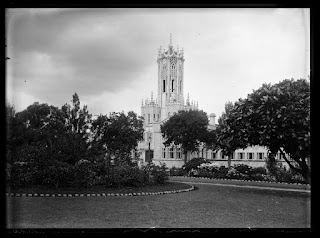
University of Auckland: Clock Tower and Old Choral Hall

Image
While exploring Heritage Images online I decided to search images of the University of Auckland out of interest as I’ve studying there for the past five years. The images are very interesting and give a gauge as to how the university has changed over the years. Ref: Henry Winkelmann, Looking across Princes Street from the Albert Park grounds..., February 1927, Sir George Grey Special Collections, Auckland Libraries, 1-W791.

Di Stewart photograph collection

Image
Auckland Libraries’ photograph collections contain over five hundred thousand images and are continually growing. Today we are spotlighting a 2013 accession of photographs taken by Di Stewart which have recently been digitised and made available online through our Heritage Images database. Ref: Di Stewart, Carnegie Library, Thames, 1990s?, Sir George Grey Special Collections, Auckland Libraries, 1200-37. Ref: Di Stewart, Queen of Beauty Mine pump quadrants, Thames, 1990s?, Sir George Grey Special Collections, Auckland Libraries, 1200-22.

Frank Sargeson's House

Image
Take a walk through Aotearoa New Zealand’s literary history in Takapuna this summer. Did you know that it is possible to take a free guided tour through Frank Sargeson’s house ? If you are interested please contact  Research Bookings on the Library website  and from there you can make an appointment to view the house. This is a wonderful opportunity to transport yourself back in time and imagine the gatherings, the discussions, literary and otherwise, that have taken place within the walls of 14 Esmonde Street, Takapuna, down the years. Ref: Andrew Henry, Sign at Frank Sargeson's house, 20 January 2015.

Aotearoa Housing - the settlers

Image
The exhibition  ‘Aotearoa Houses: settlers to hippies’ is currently running in the atrium outside the Central Auckland Research Centre on the  second  floor of the  Auckland  Central Library. On this blog we've previously featured posts on Hippie A rchitecture  and  State  Houses .  Ref: Pegler for Auckland Weekly News, Showing a settler's house at Poro-o-Tarao, with people posed outside, 19 May 1899, Sir George Grey Special Collections, Auckland Libraries, AWNS-18990519-6-1.

St. James Theatre

Image
Queen Street’s St. James Theatre has been in the news recently , with the announcement by its new owner of plans for restoration, in conjunction with the development of an adjacent 39 story residential tower. The Category 1 listed building was opened in July 1928, with a performance of the London Musical Comedy ‘Archie’. The images below are the cover and the centre pages of the programme from  that  evening:  Ref: New Zealand Ephemera -  'Archie' - A Musical Comedy In Two Acts.  Gala opening performance of the St James Theatre, July 5 1928.   Sir George Grey Special Collections, Auckland Libraries.  Ref: New Zealand Ephemera -  'Archie' - A Musical Comedy In Two Acts.  Gala opening performance of the St James Theatre, July 5 1928.   Sir George Grey Special Collections, Auckland Libraries. 

Hippie architecture: geomantic ideas and vibes

Image
                     “I was astonished by the inventive beauty of the hippie architecture,” film-maker Dan Salmon said, to the New Zealand herald , after researching New Zealand’s back-to-landers for his documentary Dirty bloody hippies .   “Some of the houses, pulled together from hand-milled timber and demolition materials were absolutely mad, others were sensibly warm and cozy, with steep-pitched roofing and attic bedrooms echoing our early pioneer cottages.” Ref: J. T. Diamond.  Old school, Wairere Road, rear view, shows the  water   tank.1960  J.T. Diamond Collection, , West Auckland Research Centre,  Auckland Libraries.   JTD-01A-01591-2 .

Auckland's Town Hall

Image
The Heritage Images database has a marvelous feature called ‘Through the decades’ that shows how a building and its surroundings change over time. Some of the significant places featured include Albert Park, the Ferry Building and in its prominent Queen Street location, the Auckland Town Hall -- a building of cultural significance noted for its unusual shape. It has been described as “a wedge of cheese or a decrepit flat iron.” The dozen photographs in the 'Through the decades' section document significant aspects of the Hall's history from its construction in 1910, to the creation of Aotea Square in the 1970s. Ref: Hubert Vaile, The Auckland Town Hall under construction, 1910, Sir George Grey Special Collections, Auckland Libraries, 2-V1409 Ref: Henry Winkelmann, Auckland Town Hall from the corner of Wakefield Street, with the Grey statue, 28 January 1921, Sir George Grey Special Collections, Auckland Libraries, 1-W1746

From gothic skyscrapers to Hathaway cottages

Image
Dotted around Auckland are a number of residential and commercial buildings designed by Canadian architect Sholto Smith (1881-1936) which are now part of Auckland’s architectural heritage.  While researching Auckland’s War Memorial libraries for the Our Boys  website, I discovered Smith was noted as the designer of the gorgeous, little Albany War Memorial Library - although there is some controversy over whether it was Smith or his business partner, Thomas Mullions who played the bigger part in the design. Ref: Jock Phillips and Chris Maclean, Albany War Memorial Library, about 1986, from nzhistory.net.nz Smith arrived in New Zealand in 1920, when he was 39 years old, and joined the architectural practice of TC Mullions and C. Fleming McDonald.  He became partner after McDonald’s death and together with Mullions went on to design both residential and commercial properties. Among them the Shortland Flats in downtown Auckland which the pair owned as a venture to...