Posts

Showing posts with the label soldiers

Commemorating - "Influenza 100"

Image
After four years of the most horrific warfare the modern world has ever known, the First World War's end was in sight. More than 10 million soldiers were killed and around the same amount of civilians. Of the number killed, 18,000 New Zealanders had been lost on the battlefields and at sea. In a population of just over a million people, the loss of 18,000 meant that no family was left untouched. The public waiting their turn at the inhalation chamber, Health Department's Buildings, Auckland. Auckland Libraries Heritage Collections, AWNS-19181114-36-3. There was a feeling of anticipation tempered with feelings of loss, for our people returning home. A cruel twist of fate meant that any celebration was curtailed, as influenza swept through the world killing upwards of 50 million people. More than the war itself. In a couple of short months approximately 9000 (over 2000 are known to be Māori) New Zealanders succumbed to the influenza and the associated secondary infections...

Ministering Angels in time of suffering

Image
Ref: James D Richardson, Steamship Maheno used as First World War hospital ship, no date, no location, Sir George Grey Special Collections, Auckland Libraries, 4-1624 During the First World War not all women saw their role as the person to keep the home fires burning. Those armed with nursing qualifications and the spirit of adventure enrolled to serve their country overseas. These dedicated professionals included nurses from the South Auckland area, who served in the New Zealand Army Nursing Service with the New Zealand Expeditionary Force. Ref: Auckland Weekly News, NZ and Aus soldiers on board a hospital ship, on the way from Lemnos Island to Alexandria, Eyqpt, 1915, Sir George Grey Special Collections, Auckland Libraries, AWNS-19150701-47-2 This post is dedicated to some of these nurses who trained in Auckland between 1912 and 1916, with the exception of Ethelwyn Carruth who trained in Thames in 1914.

Sports days

Image
The annual sports day - a ritual in the school calendar. Egg and spoon race, three-legged race, long jump, running, tug-of-war - these are always fun packed events! Its not just children though that get involved, adults are also keen to get in on the action, as the heritage photographs below show. The annual NZ community sports day was taken and adapted from those in Britain - particularly the Scottish sports days, where professional athletes compete in a wide array of contests, including wood chopping! Sports days have also been held for a wide variety of reasons: to acknowledge and commemorate particular days of the year, such as Labour Day and to raise funds for charity. This included sports days held on the home front during the First World War to raise funds for the troops. During this war time period, sports days were also held overseas on the fronts, to encourage fitness in the NZ troops, raise morale and encourage camaraderie. Enjoy this action packed tour through sports ...

'It'll be over by Christmas' - First World War exhibition at the Central City Library

Image
It was an appropriately dark and stormy night in Auckland for the opening of ' It’ll be over by Christmas ' - an exhibition about the First World War (1914-1918) at the Central City Library (9th July-12 October 2014). The guests crowded in to the exhibition ahead of the formalities and made their way back there afterwards. Ref: Paul Nash, ‘The field of Passchendaele’, from the British artist at the Front, ‘Country Life’, 1918 Bobby Newson from Te Waka Angamua (the Māori Strategy and Relations Department within council) opened the evening with a karakia/prayer and set the scene back 100 years ago. Allison Dobbie, Libraries Manager welcomed the guests and introduced the mayor. Mayor Len Brown discussed the many and varied commemorative activities Auckland Council is delivering. This includes the new Heritage Trail for Auckland sites of First World War significance, which opens in August this year.

Rats

Image
Rats are a big deal in Aotearoa/New Zealand. Not only do they pass on diseases to people and domestic animals but they also pose a serious threat to our native fauna, which is vulnerable to these exceedingly tenacious vermin. For example, in 1959 rats invaded the tiny island of Ruapuke/Maria Island in the Hauraki Gulf (part of the Noises Islands). The rats made short work of the local population of birds, killing nearly 1,000 storm petrels . Ref: Auckland Weekly News, stormy petrel, Moko Hinau Island, 1937, Sir George Grey Special Collections, Auckland Libraries, AWNS-19371006-44-8 Quick action was taken and with the aid of a Wildlife Service grant of £5 and the efforts of a Forest and Bird Protection Society group led by A. McDonald from Waiheke Island, the rat population was decimated. The island was surveyed the following year to check for signs of rats but none were found. A program of surveys and poisoning continued for a number of years until 1964 when the rat population ...

Horses in the First World War

Image
Animals played a vital part during the First World. None more so that the horse. The conflict began with the cavalry forces but as the war progressed, horses were gradually replaced by the introduction of tanks. However, horses still played a vital part in the war. The use of horses varied but the United Kingdom used mounted infantry and cavalry charges throughout the war. Shipping conditions for horses were not ideal and many arrived in poor condition. There was also no return journey for the remaining horses at the end of the war. Some were given to the British Army but the majority were sadly destroyed. One or two did make the journey home including Colonel C. G. Powles’ horse Bess and there is a memorial to her near Flock House in Manawatū. Ref: Auckland Weekly News, the NZ Expeditionary Force who are now serving in Egypt, no location, 1914, Sir George Grey Special Collections, AWNS-19141210-47-1 Horses were used for a variety of jobs, moving heavy artillery, transportation...

Remembering tūpuna who served in the First World War

Image
During the First World War, over 2,000 Māori served under the Native Contingent and the Māori Pioneer Battalion. Conscription of Māori did not take place until 1917, prior to this date, Māori involvement was purely voluntary. Changes put in place in late 1915/early 1916 led to the disestablishment of the Native Contingent and the incorporation of Māori soldiers into the New Zealand Pioneer Battalion, which is more commonly known as the Māori Pioneer Battalion. Ref: Herman John Schmidt, three privates including Pitama probably of the NZ Maori Pioneer Battalion, no location, c. 1915/1916, Sir George Grey Special Collections, Auckland Libraries, 31-P917

Maori in the First World War: How the Māori Pioneer Battalion was formed

Image
Following on from an earlier blog post this week , which discussed the establishment of the First Māori Contingent, this post looks at the involvement of these troops during the First World War. Following severe New Zealand losses the Māori Contingent were sent to Gallipoli in July 1915. They landed at ANZAC Cove on 3 July and were attached to the New Zealand Mounted Rifles Brigade.  They were employed as pioneers, digging trenches and clearing mine-spoil at Quinn’s Post and dragging water-tanks up onto Plugge’s Plateau.  They dug the Great Sap, which was an eight-foot deep communication trench wide enough to carry two stretchers side-by-side.  This ran along the beach connecting Walker’s Ridge with the northerly outposts of the ANZAC perimeter. However Māori soldiers were soon fighting in a combat role.  Second Lieutenant Thomas Grace led a team of marksmen and scouts who cleared Turkish snipers from Monash Gully. The Māori Contingent pushed the Turks off Table ...

Pacific Islanders in the First World War

Image
Updated 18 November 2016 On 23 April earlier this year members of the local Niuean community unveiled a unique war memorial in Mt Roskill’s War Memorial Park. This was the Niue Island World War I Roll of Honour : a polished black granite tablet listing the names of men from Niue Island who served in the New Zealand armed forces during the First World War: 150 men who served in the 3rd Māori Contingent and seven who served in other sections of the NZEF. Why did so many men from a tiny and remote Pacific island volunteer to serve in a war which overtly had little to do with them? Well, New Zealand had annexed both the Cook Islands and Niue in 1901. After war broke out in 1914, many local men from both protectorates were eager to enlist, some of them motivated by patriotism, most of them impelled by a sense of adventure, and the colonial administrators on the spot were keen to facilitate their recruitment. The New Zealand military authorities back home initially welcomed only volun...

Niuean Language Week

Image
Fakaalofa lahi atu. Niue Language Week runs this year from 13 to 19 October. The theme is 'Leveki mo e fakaaoga e Vagahau Niue – Treasure and use the Niue Language'. Did you know that Niueans represent our fourth-largest Pacific group in New Zealand? So it seems highly appropriate to celebrate the Niuean culture and language during this week. The language week has been organised largely by the Vagahau Niue Trust and Matakau Pulefakamotu Niue Okalana, with support from the Ministry of Pacific Island Affairs. Check out the ministry's Facebook page for more information and the programme to find out what is happening near you. Enjoy the selection of  heritage photos below, which are drawn from the heritage collections at Auckland Libraries, to celebrate Niue Language Week. Niuean royalty: Ref: AWNS-19001005-3-3, the King and Queen of Niue with the NZ Premier and Mrs Seddon, Niue, 1900, Sir George Grey Special Collections

Thinking about WW1 centenary commemorations

Image
I can’t believe the speed at which 2013 is hurtling along, and that 2014 - and with it the centenary of the outbreak of WW1 – will soon be here. Not an anniversary to celebrate, of course, but a time to reflect on the suffering humanity is capable of inflicting upon itself. Ref: 35-R2163, Anzac parade, Sir George Grey Special Collections Over 100,000 New Zealanders took part in the conflict, and almost 20,000 lost their lives. Many New Zealand soldiers had their portraits taken before they left for Europe, and Herman Schmidt’s Studio in Auckland’s Queen Street was a favourite place to be photographed. 4,500 of Schmidt’s WW1 soldier portraits have survived and can be seen on the Auckland Libraries’ Heritage Images database . You can also see a virtual exhibition of the Herman Schmidt’s work

Herman John Schmidt

Image
It sounds like something out of a movie but it is true .... In 1970, a construction worker found a large number of glass-plate negatives stored in the attic of the Edson’s Building, a century-old structure at 270 Queen Street, Auckland which was marked for demolition . News of this discovery travelled fast and when deputy librarian Wynne Colgan and New Zealand reference librarian Pat French heard about it, they organised a speedy rescue mission. A team of determined rescuers climbed repeatedly up into the attic and carried out the precious find. Around 26,000 half plate and whole plate negatives were saved. These images represented the lifetime’s work of the gifted and versatile photographer Herman John Schmidt (1872-1959). Amazingly, Schmidt’s accession registers and day books were also found and saved - these have proved to be essential for identifying the subjects of his portraits. Ref: 31-WP626, Schmidt family, by Herman Schmidt, c.1910s, Sir George Grey Special Collections ...

Anzac Day

Image
First marked in 1916, Anzac Day commemorates all the New Zealanders killed in war and it also honours returned servicemen and women. The commemoration date, 25th April, remembers the date that the New Zealand and Australian soldiers or the Anzacs landed on the Gallipoli Peninsula in 1915. To commemorate and reflect upon this important day, here are a selection of Auckland Libraries' heritage images relating to Anzac Day, which are drawn from around the region and across the decades. West: Ref: JTD-11K-01640-2, unveiling of New Lynn War Memorial on Anzac Day, 25 April 1958, West Auckland Research Centre Ref: JTD-05J-03183, trampers at remains of wartime road block, Karekare, 1945, West Auckland Research Centre Ref: JTD-04K-03812, unveiling of War Memorial on Lion Rock, 1920, West Auckland Research Centre North: Ref: N0111016, Anzac Day gathering, Northcote, 1920s, North Auckland Research Centre Ref: T1172, barbed wire defences on Takapuna Beach during World...

2nd Battle of El Alamein

Image
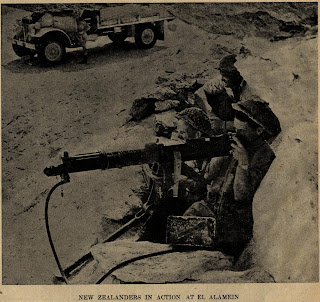
Sixty years ago, the 2nd Battle of El Alamein , the battle that turned the war towards the allies' favour, was fought in North Africa. Recent commemorations saw New Zealand veterans invited to the El Alamein Commonwealth War Graves Cemetery in Egypt to remember New Zealand and allied forces; fortunately many of their stories now live on in the written and oral histories. George Mackay from Westport fought at Tripoli and in The Desert Rd  recounts the thoughts that go through one’s mind leading up to battle. “You don’t know what to expect.. . It’s an uncanny moment, zero hour. Everything’s going through your mind, whether you’ll survive, whether you’re going to get killed, blown up or shot at, or anything like that. What’s going to happen? What’s it going to be like? You don’t know. All those things are going through your mind and then finally its zero hour and the shelling starts. Then you’re waiting for the Germans to retaliate with their shells.  That’s what it’s all ab...