Posts

Showing posts with the label war

In the West, Much News

Image
In late January 1929, Erich Maria Remarque’s anti-war novel Im Westen, Nichts Neues ( In the west, nothing new ) was published by Propyläen Verlag. In England the book was quickly translated by the Australian librarian Arthur Wesley Wheen and republished under the title All Quiet on the Western Front . Ref:  Two original 1929 editions that finally made it into the Library, t he one on the left is from the Quaker Collection .

Wartime Propaganda - Germans, Turks and Austrians as seen by the Auckland Weekly News

Image
This year Auckland Libraries remembers it is 100 years since New Zealand’s first major baptism of fire during the First World War when our troops landed at Gallipoli on 25 April 1915. To commemorate that event Sir George Grey Special Collections staff are working to make the Auckland Weekly News Supplement photographs from 1915 more searchable for researchers, librarians and readers who look at the Heritage Images in our Digital Library . These photographs feature events and people from all major war fronts but also include New Zealand personalities and scenes. How our attitudes to the people who were then our enemies have changed during the past 100 years! But back then Auckland Weekly News caption-writers jingoistically stirred up public hatred for the Germans, contempt of the Turks and mockery of the Austrians. The depths of German depravity were unfathomable as this propaganda cartoon of German troops massacring Belgian citizens in Louvain shows. Ref: M Matthews f...

Ministering Angels in time of suffering

Image
Ref: James D Richardson, Steamship Maheno used as First World War hospital ship, no date, no location, Sir George Grey Special Collections, Auckland Libraries, 4-1624 During the First World War not all women saw their role as the person to keep the home fires burning. Those armed with nursing qualifications and the spirit of adventure enrolled to serve their country overseas. These dedicated professionals included nurses from the South Auckland area, who served in the New Zealand Army Nursing Service with the New Zealand Expeditionary Force. Ref: Auckland Weekly News, NZ and Aus soldiers on board a hospital ship, on the way from Lemnos Island to Alexandria, Eyqpt, 1915, Sir George Grey Special Collections, Auckland Libraries, AWNS-19150701-47-2 This post is dedicated to some of these nurses who trained in Auckland between 1912 and 1916, with the exception of Ethelwyn Carruth who trained in Thames in 1914.

Sports days

Image
The annual sports day - a ritual in the school calendar. Egg and spoon race, three-legged race, long jump, running, tug-of-war - these are always fun packed events! Its not just children though that get involved, adults are also keen to get in on the action, as the heritage photographs below show. The annual NZ community sports day was taken and adapted from those in Britain - particularly the Scottish sports days, where professional athletes compete in a wide array of contests, including wood chopping! Sports days have also been held for a wide variety of reasons: to acknowledge and commemorate particular days of the year, such as Labour Day and to raise funds for charity. This included sports days held on the home front during the First World War to raise funds for the troops. During this war time period, sports days were also held overseas on the fronts, to encourage fitness in the NZ troops, raise morale and encourage camaraderie. Enjoy this action packed tour through sports ...

'It'll be over by Christmas' - First World War exhibition at the Central City Library

Image
It was an appropriately dark and stormy night in Auckland for the opening of ' It’ll be over by Christmas ' - an exhibition about the First World War (1914-1918) at the Central City Library (9th July-12 October 2014). The guests crowded in to the exhibition ahead of the formalities and made their way back there afterwards. Ref: Paul Nash, ‘The field of Passchendaele’, from the British artist at the Front, ‘Country Life’, 1918 Bobby Newson from Te Waka Angamua (the Māori Strategy and Relations Department within council) opened the evening with a karakia/prayer and set the scene back 100 years ago. Allison Dobbie, Libraries Manager welcomed the guests and introduced the mayor. Mayor Len Brown discussed the many and varied commemorative activities Auckland Council is delivering. This includes the new Heritage Trail for Auckland sites of First World War significance, which opens in August this year.

Horses in the First World War

Image
Animals played a vital part during the First World. None more so that the horse. The conflict began with the cavalry forces but as the war progressed, horses were gradually replaced by the introduction of tanks. However, horses still played a vital part in the war. The use of horses varied but the United Kingdom used mounted infantry and cavalry charges throughout the war. Shipping conditions for horses were not ideal and many arrived in poor condition. There was also no return journey for the remaining horses at the end of the war. Some were given to the British Army but the majority were sadly destroyed. One or two did make the journey home including Colonel C. G. Powles’ horse Bess and there is a memorial to her near Flock House in Manawatū. Ref: Auckland Weekly News, the NZ Expeditionary Force who are now serving in Egypt, no location, 1914, Sir George Grey Special Collections, AWNS-19141210-47-1 Horses were used for a variety of jobs, moving heavy artillery, transportation...

Remembering tūpuna who served in the First World War

Image
During the First World War, over 2,000 Māori served under the Native Contingent and the Māori Pioneer Battalion. Conscription of Māori did not take place until 1917, prior to this date, Māori involvement was purely voluntary. Changes put in place in late 1915/early 1916 led to the disestablishment of the Native Contingent and the incorporation of Māori soldiers into the New Zealand Pioneer Battalion, which is more commonly known as the Māori Pioneer Battalion. Ref: Herman John Schmidt, three privates including Pitama probably of the NZ Maori Pioneer Battalion, no location, c. 1915/1916, Sir George Grey Special Collections, Auckland Libraries, 31-P917

Anzac Day

Image
This year's Anzac Day takes on special significance with the start of the upcoming centenary of the First World War being marked in August. The library also has a range of heritage images showing Anzac Day scenes over the years, such as services, parades, memorials and banners. You can search for these by using the keyword Anzac in the search box of  the heritage databases:  Heritage Images , Local History Online and Footprints . We have put together a selection for you below and as you look through these, take a moment to remember all the servicemen and servicewomen who have served for their country. Services: Ref: Photographer unknown, Anzac Day ceremony, Papatoetoe, c. 1970s, photograph reproduced by courtesy of Mr Neil Closey (via Cheryl Fowler), South Auckland Research Centre, Auckland Libraries, Footprints 01506 Ref: Photographer unknown, Anazac service, Auckland Town Hall, corner of Greys Ave and Queen St, c. 1922-1929, Sir George Grey Special Collections...

Pacific Islanders in the First World War

Image
Updated 18 November 2016 On 23 April earlier this year members of the local Niuean community unveiled a unique war memorial in Mt Roskill’s War Memorial Park. This was the Niue Island World War I Roll of Honour : a polished black granite tablet listing the names of men from Niue Island who served in the New Zealand armed forces during the First World War: 150 men who served in the 3rd Māori Contingent and seven who served in other sections of the NZEF. Why did so many men from a tiny and remote Pacific island volunteer to serve in a war which overtly had little to do with them? Well, New Zealand had annexed both the Cook Islands and Niue in 1901. After war broke out in 1914, many local men from both protectorates were eager to enlist, some of them motivated by patriotism, most of them impelled by a sense of adventure, and the colonial administrators on the spot were keen to facilitate their recruitment. The New Zealand military authorities back home initially welcomed only volun...

'Our boys, our families' research guide

Image
As part of the build up to the First World War centenary commemorations within NZ and around the world, Auckland Libraries, Auckland Council Heritage Unit and Auckland Council Archives have developed an A5 research guide. 'Our boys, our families' outlines the First World War resources available at Auckland Libraries and Auckland Council Archives . This includes: Rolls of Honour, cemetery records, memorials, books and photographs from the Schmidt Collection and supplement to the Auckland Weekly News. Ref: 7-A14534, a family receiving the result of the ballot for Class B reservists under the NZ Military Service Act, 1918, Sir George Grey Special Collections The research guide is intended to assist you with your own research into family members or people who took part in the war. This could be a soldier on the front line, a nurse on a hospital ship or a person on the home front including conscientious objectors. There are a selection of handy research prompts tucked into t...

C Company 28 Māori Battalion Memorial House to be built

Image
Ref: AWNS-19400703-31-1, new recruits to the Maori Battalion in training & leisure at the Papakura Camp, 1940, Sir George Grey Special Collections Half a million dollars will be contributed by the government towards the construction of a C Company 28 Māori Battalion Memorial House on land adjacent to the Tairawhiti Museum . This recognises the huge contribution of C Company to the nation and its special place in NZ history. Ref: AWNS-19430526-13-3, members of the Maori Battalion help clear up the bomb-torn waterfront of Tripoli, 1943, Sir George Grey Special Collections The concept design also recognises the sacrifice by Horouta Waka District Māori in other conflicts including: The Boer War, WW1, Korea, Malaya, and contemporary war settings such as Bosnia, East Timor and Afghanistan.

Thinking about WW1 centenary commemorations

Image
I can’t believe the speed at which 2013 is hurtling along, and that 2014 - and with it the centenary of the outbreak of WW1 – will soon be here. Not an anniversary to celebrate, of course, but a time to reflect on the suffering humanity is capable of inflicting upon itself. Ref: 35-R2163, Anzac parade, Sir George Grey Special Collections Over 100,000 New Zealanders took part in the conflict, and almost 20,000 lost their lives. Many New Zealand soldiers had their portraits taken before they left for Europe, and Herman Schmidt’s Studio in Auckland’s Queen Street was a favourite place to be photographed. 4,500 of Schmidt’s WW1 soldier portraits have survived and can be seen on the Auckland Libraries’ Heritage Images database . You can also see a virtual exhibition of the Herman Schmidt’s work

Herman John Schmidt

Image
It sounds like something out of a movie but it is true .... In 1970, a construction worker found a large number of glass-plate negatives stored in the attic of the Edson’s Building, a century-old structure at 270 Queen Street, Auckland which was marked for demolition . News of this discovery travelled fast and when deputy librarian Wynne Colgan and New Zealand reference librarian Pat French heard about it, they organised a speedy rescue mission. A team of determined rescuers climbed repeatedly up into the attic and carried out the precious find. Around 26,000 half plate and whole plate negatives were saved. These images represented the lifetime’s work of the gifted and versatile photographer Herman John Schmidt (1872-1959). Amazingly, Schmidt’s accession registers and day books were also found and saved - these have proved to be essential for identifying the subjects of his portraits. Ref: 31-WP626, Schmidt family, by Herman Schmidt, c.1910s, Sir George Grey Special Collections ...

Fighter pilots

Image
We have in the Central City Library an old but most gorgeous book that I would love to have a copy of. 'Pilots of Fighter Command ' (1942) is a book of 64 charcoal portraits of fighter pilots drawn by Cuthbert Orde , an artist and a pilot in the First World War. Over a one year period in 1941, Orde spent time living on RAF bases to draw pictures of the men who would become known as the “Few” -  the airmen of the RAF who flew in the Battle of Britain . The term had come from Winston Churchill’s phrase "Never, in the field of human conflict, was so much owed by so many to so few" and as Orde wrote: “I went off to find myself in the middle of  a world that was the talk of the world.” As well as the portraits themselves, the book includes Orde's thoughts on the pilots and gives an account of life on a fighter station during the Battle of Britain – “ordinary chaps doing an extraordinary thing.” Ref: Bendan 'Paddy' Finucane, from 'Pilots of Fighter ...

Papers Past

Image
Papers Past contains the digitised content from key New Zealand newspapers and periodicals. It's a veritable treasure trove! Overall content in Papers Past covers the years from 1839 to 1945 and includes 77 publications from all regions of New Zealand. And all of this content is fully searchable using a basic keyword search or a more advanced search option, which allows you to narrow your search down using dates and content type (e.g. articles, adverts). Papers Past have recently added 40 years worth of the New Zealand Herald , covering the period from 1885 to1924. Content on the system starts in 1863, when the paper was established. Previous installments of digitised content, (as mentioned in blog post on 8 August 2013), took the reader up to 1864, so it is great to have to have the start of the 20th century added. Ref: 1-W625, Looking west from Queen Street up Wyndham Street showing the premises of the NZ Herald, 1925, Sir George Grey Special Collections

Second World War diary reveals what life was like inside POW camps

Image
Ref: 7-A16555,  NZ POWs alongside camp huts, 1944, Sir George Grey Special Collections Margaret Pollock found the tattered blue diary of her late father Laurence after his death in 1989 in amongst newspaper clippings and prisoner of war artifacts. The diary details Laurence's time in German, Polish and Italian POW camps during the second World War. Laurence  was serving in the 20th Battalion, 2nd New Zealand Expeditionary Forces in North Africa when he was captured by German forces. He risked his life to record the horrific and harrowing conditions inside the camps.

Anzac Day

Image
First marked in 1916, Anzac Day commemorates all the New Zealanders killed in war and it also honours returned servicemen and women. The commemoration date, 25th April, remembers the date that the New Zealand and Australian soldiers or the Anzacs landed on the Gallipoli Peninsula in 1915. To commemorate and reflect upon this important day, here are a selection of Auckland Libraries' heritage images relating to Anzac Day, which are drawn from around the region and across the decades. West: Ref: JTD-11K-01640-2, unveiling of New Lynn War Memorial on Anzac Day, 25 April 1958, West Auckland Research Centre Ref: JTD-05J-03183, trampers at remains of wartime road block, Karekare, 1945, West Auckland Research Centre Ref: JTD-04K-03812, unveiling of War Memorial on Lion Rock, 1920, West Auckland Research Centre North: Ref: N0111016, Anzac Day gathering, Northcote, 1920s, North Auckland Research Centre Ref: T1172, barbed wire defences on Takapuna Beach during World...

The Waikato War

Image
Discover New Zealand's past by travelling in the path of the Waikato War 1863-1864 . Hamilton and Waikato Tourism have teamed up with the New Zealand Historic Places Trust (NZHPT) to create a interactive way for people to understand and 'experience' the Waikato War. As NZHPT archaeologist Nigel Prickett says, 'The best way of understanding what happened at these places is to go there". The website is split into historical content and driving tour information including further information about key sites. The driving tour includes 13 major historical sites to visit along the way from Highwic in Auckland to Alexandra Redoubt in Pirongia. Ref: 435-C545, Highwic, Sir George Grey Special Collections

International Tracing Service

Image
The International Commission for the International Tracing Service (ICITS)  is handing over management of the International Tracing Service in Bad Arolsen to the German Federal Archives (Bundesarchiv) after over 50 years. The ICITS will continue to give technical expertise, helping the ITS serve the victims of Nazi persecution and their families. Ref: T7129, North Auckland Research Centre The archives cover civilians detained in Nazi concentration or labour camps and people who had to flee their homes because of World War II. They house over 50 million card files relating to more than 17.5 million civilians persecuted by the Nazis.

2nd Battle of El Alamein

Image
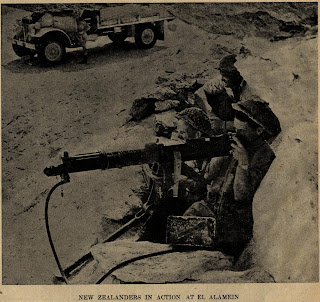
Sixty years ago, the 2nd Battle of El Alamein , the battle that turned the war towards the allies' favour, was fought in North Africa. Recent commemorations saw New Zealand veterans invited to the El Alamein Commonwealth War Graves Cemetery in Egypt to remember New Zealand and allied forces; fortunately many of their stories now live on in the written and oral histories. George Mackay from Westport fought at Tripoli and in The Desert Rd  recounts the thoughts that go through one’s mind leading up to battle. “You don’t know what to expect.. . It’s an uncanny moment, zero hour. Everything’s going through your mind, whether you’ll survive, whether you’re going to get killed, blown up or shot at, or anything like that. What’s going to happen? What’s it going to be like? You don’t know. All those things are going through your mind and then finally its zero hour and the shelling starts. Then you’re waiting for the Germans to retaliate with their shells.  That’s what it’s all ab...