Posts

What’s in a cartoon? Some ideas and examples from 1920

Image
Elementary, my dear Watson. Not so. Sometimes editorial cartoons can just be humorous or ‘funny-peculiar’ pictures, but very often they have deep, intriguing meanings for readers based on current news of the day. This is usually the case with political cartoons, which use wit, satire and symbolism to convey their clearsighted but ironically subversive messages. Here is a selection of cartoons published by the Auckland Weekly News during 1920, with some ideas about what they mean. Image: Auckland Weekly News. His Majesty the Jockey, 10 June 1920. Auckland Libraries Heritage Collections,AWNS-19200610-35-5 Our first cartoon is by Weekly News cartoonist Trevor Lloyd. He entitled it ‘His Majesty the Jockey’ because the Auckland tram strike supporting the jockeys’ work grievances took place on King’s Birthday, 1920. To interpret the cartoon, you should consult Papers Past about the jockeys’ work dispute and the tram strike. The tramwaymen refused to run trams going to the races at E...
The Reed Dumas Collection and the mystery of Madame Giovanni

Image
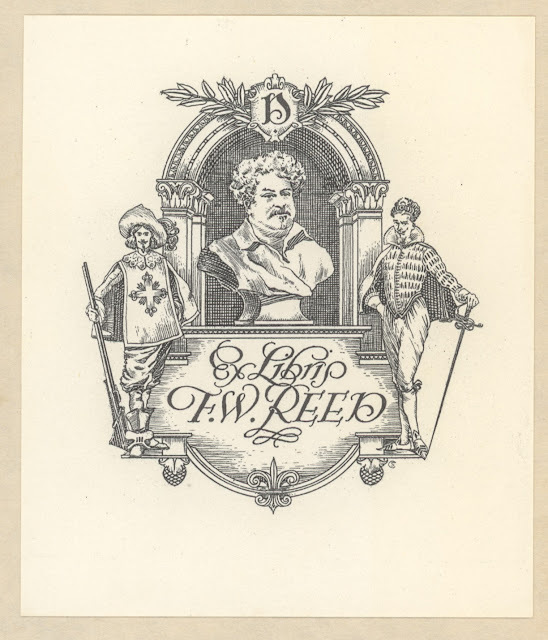
One of the extraordinary collections at Auckland Libraries is the Reed Dumas Collection. This extends to some 3,350 volumes of printed works as well as over 2,000 sheets written by Alexandre Dumas (père) (1802 – 1870). Image: Bookplate for the Reed Dumas Collection, Auckland Libraries Heritage Collections. Iain Sharp’s essay in Real Gold , the library’s treasure book, provides an excellent introduction to the extraordinary Reed Dumas Collection. Image: Items in the Reed Dumas Collection, Auckland Libraries Heritage Collections. This collection is a life’s work developed by Frank Wild Reed (1874 – 1953), a Whangārei chemist and avid Dumas collector. Bequeathed to Auckland Libraries after his death in 1953, it is a treasure trove dedicated to the larger-than-life polymath Alexandre Dumas. FW Reed was the brother of Alfred Hamish Reed, who established one of New Zealand’s first publishing firms. The Reed Dumas collection can be explored through many paths. The first editions of Dumas fam...

What kind of news magazine was the Auckland Weekly News?

Image
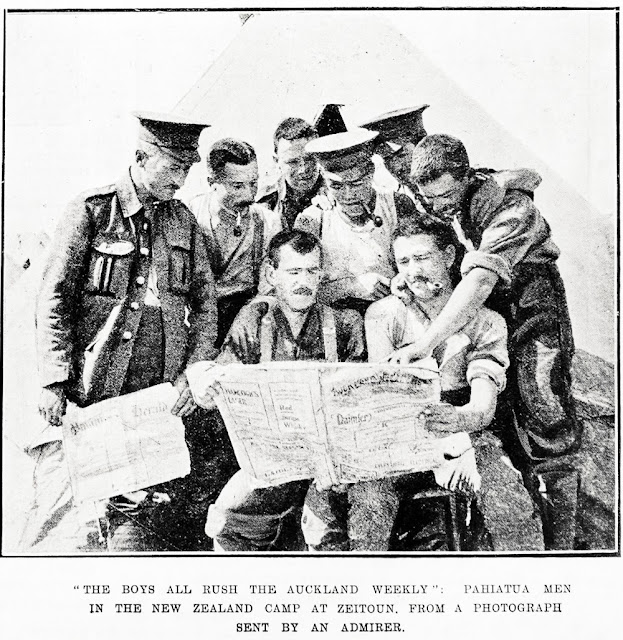
Auckland newspaper publishers Wilson and Horton Ltd produced the first issue of the Weekly News: a journal of commerce, agriculture, politics, literature, science and art on Saturday 28 November 1863, only a few months after they started publishing the New Zealand Herald . The publishers’ intention was that it should be a weekly magazine for rural towns and isolated households which was a digest of news from the Heralds of the preceding week. As well as summarising the news the magazine included a few extra illustrations; then still uncommon in newspapers. At first these were line engravings but the 1900s saw the first use of black-and-white photographs, usually in a detachable picture supplement. The new magazine was published at Wilson & Horton’s printery in Auckland but was distributed in North Island country districts beyond the city (and, eventually, throughout New Zealand.) Therefore, very soon it made sense to rename the magazine with the more explanatory Auckland Weekly Ne...

William Caxton's Golden Legend

Image
Among the Auckland Libraries collection of incunabula - early printed books - is a copy of the Golden Legend printed by William Caxton in 1483, which is one of only 33 surviving copies in the world. Detail of the Golden Legend ; the printed English is comprehensible to the modern reader. William Caxton was born about 1422 and died about 1491. He is thought to be the first person to introduce a printing press into England and the first English retailer of printed books - most significantly, books in the English language, which he translated from earlier medieval and classical texts. After working in Bruges and seeing the recently-invented printing press in action, Caxton returned to England and set up a press in Westminster in 1476. He had translated a collection of stories associated with Homer's Iliad, the Recuyell of the Historyes of Troye , and his printed version was in high demand. Realising there was a market for English language texts, he produced an edition of Chaucer'...