Posts

Showing posts with the label WW2

Piha Radar Station

Image
Ref: JTD-04A-01111, Piha Number 4 Radar Station antenna, 1958, West Auckland Research Centre The Piha Radar Station was constructed during WW2 by the NZ Air Force. Located at the end of Log Race Road in the Waitakere Ranges Regional Park, it was part of a network of radar stations along New Zealand's coast. The purpose of this site was to use radio wave transmission aerials and receiving equipment to detect any signs of attack from enemy aircrafts or vessels. Ref: JTD-04J-01110, Te Ahuahu Road and radar station, 1958, West Auckland Research Centre The site was closed permanently in the 1950s and the buildings and other structures removed. However, there are remains that can still be seen, including the concrete pads where the aerial tower once stood. Ref: JTD-04A-00307-1, remains at radar station site and Hikurangi beacon, 1963, West Auckland Research Centre This site has been added to the schedule of significant historic heritage places in the Proposed Auckland Uni...
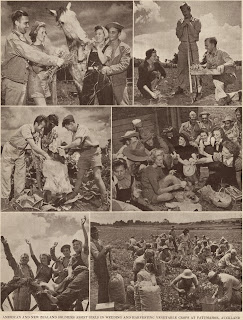
Government gardens in South Auckland

Image
70 years ago the Patumahoe State Gardens were established in the Franklin District. Bountiful supplies of vegetables were to be grown there for the remainder of the war years. From the early to mid 1940s parts of the NZ countryside were acquisitioned by the Department of Agriculture and used for the purpose of increasing large scale vegetable production. The department implemented its Services Vegetable Production Scheme in 1942. These farms were established to address the need to feed US troops stationed here during WW2. The gardens became known as 'State Farms' or 'Government Gardens'. Within six months the NZ government had established 7 state farms totalling 663 acres; the total later grew to 27 farms covering 5,200 acres. A significant number of these were based in the South Auckland region from Mangere to Pukekohe and Waiuku. By the end of 1945 all of state farms had closed down. Ref: AWNS-19431222-15-1, American and NZ soldiers at the wedding and harvesting...

Fighter pilots

Image
We have in the Central City Library an old but most gorgeous book that I would love to have a copy of. 'Pilots of Fighter Command ' (1942) is a book of 64 charcoal portraits of fighter pilots drawn by Cuthbert Orde , an artist and a pilot in the First World War. Over a one year period in 1941, Orde spent time living on RAF bases to draw pictures of the men who would become known as the “Few” -  the airmen of the RAF who flew in the Battle of Britain . The term had come from Winston Churchill’s phrase "Never, in the field of human conflict, was so much owed by so many to so few" and as Orde wrote: “I went off to find myself in the middle of  a world that was the talk of the world.” As well as the portraits themselves, the book includes Orde's thoughts on the pilots and gives an account of life on a fighter station during the Battle of Britain – “ordinary chaps doing an extraordinary thing.” Ref: Bendan 'Paddy' Finucane, from 'Pilots of Fighter ...

Second World War diary reveals what life was like inside POW camps

Image
Ref: 7-A16555,  NZ POWs alongside camp huts, 1944, Sir George Grey Special Collections Margaret Pollock found the tattered blue diary of her late father Laurence after his death in 1989 in amongst newspaper clippings and prisoner of war artifacts. The diary details Laurence's time in German, Polish and Italian POW camps during the second World War. Laurence  was serving in the 20th Battalion, 2nd New Zealand Expeditionary Forces in North Africa when he was captured by German forces. He risked his life to record the horrific and harrowing conditions inside the camps.

Anzac Day

Image
First marked in 1916, Anzac Day commemorates all the New Zealanders killed in war and it also honours returned servicemen and women. The commemoration date, 25th April, remembers the date that the New Zealand and Australian soldiers or the Anzacs landed on the Gallipoli Peninsula in 1915. To commemorate and reflect upon this important day, here are a selection of Auckland Libraries' heritage images relating to Anzac Day, which are drawn from around the region and across the decades. West: Ref: JTD-11K-01640-2, unveiling of New Lynn War Memorial on Anzac Day, 25 April 1958, West Auckland Research Centre Ref: JTD-05J-03183, trampers at remains of wartime road block, Karekare, 1945, West Auckland Research Centre Ref: JTD-04K-03812, unveiling of War Memorial on Lion Rock, 1920, West Auckland Research Centre North: Ref: N0111016, Anzac Day gathering, Northcote, 1920s, North Auckland Research Centre Ref: T1172, barbed wire defences on Takapuna Beach during World...

International Tracing Service

Image
The International Commission for the International Tracing Service (ICITS)  is handing over management of the International Tracing Service in Bad Arolsen to the German Federal Archives (Bundesarchiv) after over 50 years. The ICITS will continue to give technical expertise, helping the ITS serve the victims of Nazi persecution and their families. Ref: T7129, North Auckland Research Centre The archives cover civilians detained in Nazi concentration or labour camps and people who had to flee their homes because of World War II. They house over 50 million card files relating to more than 17.5 million civilians persecuted by the Nazis.