Posts

Showing posts with the label built heritage

Merrilands Garden Suburb

Image
We have to announce that the Merrilands Garden Suburb, Auckland’s most glorious heritage, situated on the green, grassy slopes of One Tree Hill is at last thrown open to the public and the choice of this, the finest and largest subdivision, ever offered in Auckland is now to be yours.” (Advertisement, Auckland Star, 7 December 1923) Merrilands! It was the name given to a 500-section subdivision on the slopes of Maungakiekie/One Tree Hill, that ran down towards Mt Smart Road, and was promoted by its developers as a Garden Suburb. With visions of green spaces and healthy living it would have tapped into the awareness of overcrowding and unsatisfactory housing conditions that were ripe not only in Auckland but in other parts of the country, too.  Image: Backyard of the same houses at the head of Blind Lane, Wellington, Auckland Libraries Heritage Collections NZG-19110719-0021-02 In the 1920s, Merrilands wasn’t the only new subdivision to be promoted as a garden suburb. In 1922 adverti...

The hundred-year-old Papatoetoe Town Hall (part 2)

Image
On 27 February 2018 Papatoetoe will celebrate the centenary of one of its most iconic buildings, the Papatoetoe Town Hall. A centenary dinner will be held in the hall and stories and photographs from residents and community groups who have used the building over the years will be on display (contact jennya.clark@xtra.co.nz for details). This is the second part of a history of the hall. Read about the early years in The hundred-year-old Papatoetoe Town Hall (part 1) . Papatoetoe Civic War Memorial The section where the library stood was an obvious site for development, and Papatoetoe Borough Council decided to develop a war memorial building there. The makeshift library building was thus removed and, during an impressive open-air ceremony held on 8 October 1955, the Papatoetoe Civic War Memorial was opened in its place. This was a dignified two-storey building housing a new and much expanded public library downstairs, and a meeting room or ‘concert chamber’ and new Borough Council ...

Churches in Onehunga

Image
There are several historic churches in Onehunga, reflecting the early European settlement of the area. Early Church Services in Onehunga The first church services in Onehunga were held on the first Sunday (21 November 1847) after the arrival of the first contingent of the Fencibles . There was an Anglican service in the morning and a Catholic service in the afternoon. St Peter’s Anglican Church St Peter’s Church was one of the earliest churches in Auckland, constructed in 1848. The first service was held on Saint Peter’s Day, 29 June 1848.The stone wall at the church was built in 1853, a part of which still stands. In 1857, the tower and the spire were moved to the south side of the church. As the numbers of people attending the church grew, the original wooden church was extended in the 1860s and 1870s. Ref: St Peters Church, Onehunga, 1860s, Sir George Grey Special Collections, Auckland Libraries, 957-192-1.

The little church that wouldn’t die

Image
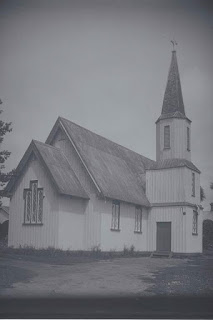
Later this year The church on the corner: a history of Selwyn Church Māngere East, 1863-2012 will be published. Selwyn Church started life 153 years ago in Ōtāhuhu when local Anglicans built a new wooden church in Victoria Street (now Mason Avenue). It was dedicated as the Church of the Holy, Blessed and Undivided Trinity on St John the Evangelist’s Day, 27 December 1863 by Bishops George Augustus Selwyn and John Coleridge Patteson . Ref: James D Richardson, Old Holy Trinity Church, Ōtāhuhu, c 1900-1919, Sir George Grey Special Collections, Auckland Libraries, 4-8789.

Milan Mrkusich’s public art

Image
One of New Zealand’s most highly respected abstract artists, Milan Mrkusich , designed several large public artworks in Auckland in the 1950s-1960s. The most well-known existing ones include the mosaic mural on the B. J. Ball Building overlooking Fanshawe Street, and the stained glass windows at Grey Lynn’s St Joseph’s Catholic Church - the largest abstract work in the country at that time. Ref: Patrick Clearwater, BJ Ball mural, 31 May 2010. B. J. Ball (NZ) Ltd was a paper manufacturing company and Mrkusich’s mural for them highlights the paper-making process from the raw material of trees to the end product of stacks of reams. This mural is 7.6m high and 3.9m wide (25ft x13 ft.) and is made from thousands of glass and ceramic tiles. As Julian Dashper recounts in a 1995 article, Mrkusich made full size plan drawings “which he rolled up and posted to Italy, where a master tile maker made a complete mural on the floor, turned it upside down into hundreds of little boxes and ...

Lower Queen Street

Image
As the City Rail Link (CRL) project begins and Lower Queen Street has become predominantly closed to traffic, we take a look back at the varying ways that the space has been used. Lower Queen Street, between Customs Street and Quay Street, currently sits on reclaimed land that used to be part of Commercial Bay. Reclamation works in the area occurred between 1875 and 1886. Ref: Auckland Weekly News, Lower Queen Street Auckland near the wharf and Railway station, 7 December 1900, Sir George Grey Special Collections, Auckland Libraries, AWNS-19001207-7-2.

University of Auckland: Clock Tower and Old Choral Hall

Image
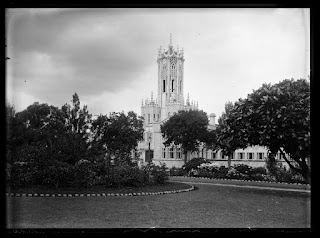
While exploring Heritage Images online I decided to search images of the University of Auckland out of interest as I’ve studying there for the past five years. The images are very interesting and give a gauge as to how the university has changed over the years. Ref: Henry Winkelmann, Looking across Princes Street from the Albert Park grounds..., February 1927, Sir George Grey Special Collections, Auckland Libraries, 1-W791.

Di Stewart photograph collection

Image
Auckland Libraries’ photograph collections contain over five hundred thousand images and are continually growing. Today we are spotlighting a 2013 accession of photographs taken by Di Stewart which have recently been digitised and made available online through our Heritage Images database. Ref: Di Stewart, Carnegie Library, Thames, 1990s?, Sir George Grey Special Collections, Auckland Libraries, 1200-37. Ref: Di Stewart, Queen of Beauty Mine pump quadrants, Thames, 1990s?, Sir George Grey Special Collections, Auckland Libraries, 1200-22.

The Inside Story – tales behind the names in Massey.

Image
We often don’t give a second thought to the stories behind the names of our roads, schools, creeks and more, but delving into the history of Massey I have unearthed some interesting facts and anecdotes. The suburb itself was named in 1915 after one of New Zealand’s most significant politicians, the then Prime Minister William Ferguson Massey (1856-1925).  Prior to that, the sparsely populated area was known as Lawsonville, after settler John Lawson who had an orchard by the creek that also bears his name. Elizabeth Freeman (nee Gregory), who was born in Lawsonville in 1898, described it as, “wilderness, supporting a few cottages…a windswept, low [manukau] scrub desolate area, the ground being exceptionally poor”. Lawson’s Creek was home to a number of gum diggers who built simple whare on its banks. Read an 1889 New Zealand Herald article reporting the fate that befell one such man. Ref: J.T. Diamond, Waterfall at head of Lawson’s inlet, December 1962, West Auck...

Frank Sargeson's House

Image
Take a walk through Aotearoa New Zealand’s literary history in Takapuna this summer. Did you know that it is possible to take a free guided tour through Frank Sargeson’s house ? If you are interested please contact  Research Bookings on the Library website  and from there you can make an appointment to view the house. This is a wonderful opportunity to transport yourself back in time and imagine the gatherings, the discussions, literary and otherwise, that have taken place within the walls of 14 Esmonde Street, Takapuna, down the years. Ref: Andrew Henry, Sign at Frank Sargeson's house, 20 January 2015.

Aotearoa Housing - the settlers

Image
The exhibition  ‘Aotearoa Houses: settlers to hippies’ is currently running in the atrium outside the Central Auckland Research Centre on the  second  floor of the  Auckland  Central Library. On this blog we've previously featured posts on Hippie A rchitecture  and  State  Houses .  Ref: Pegler for Auckland Weekly News, Showing a settler's house at Poro-o-Tarao, with people posed outside, 19 May 1899, Sir George Grey Special Collections, Auckland Libraries, AWNS-18990519-6-1.

An inside view of Freemasonry from Auckland’s United Masters Lodge No. 167

Image
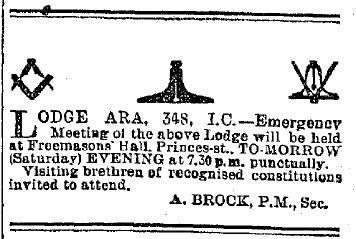
The history of freemasonry in New Zealand goes back to the 1830’s and includes members such as Sir George Grey , former Prime Minister William Ferguson Massey , Sir Peter Buck and Sir Mason Durie . Now 100 years of local and international Masonic history is available to view on a CD-ROM containing Auckland’s United Masters Lodge No. 167 Transactions periodical, 1909-2009, revealing a detailed picture of Freemasons’ ethics, ceremonies and symbols. Several items document early Freemasons activities in Auckland including the first recorded meeting at which members were present - the laying of the foundation stone of St Paul’s Anglican Church, then in Emily Place, in 1841. Ref: Excerpt from Auckland Star, Volume XXVI, Issue 231, 27 September 1895, p.5. The first Lodge in Auckland to build its own meeting place, Ara Lodge, held their meetings in the Exchange Motel, Shortland Street, before moving in February 1844 to the Royal Hotel, where the Northern Club now stands. In 1...

St. James Theatre

Image
Queen Street’s St. James Theatre has been in the news recently , with the announcement by its new owner of plans for restoration, in conjunction with the development of an adjacent 39 story residential tower. The Category 1 listed building was opened in July 1928, with a performance of the London Musical Comedy ‘Archie’. The images below are the cover and the centre pages of the programme from  that  evening:  Ref: New Zealand Ephemera -  'Archie' - A Musical Comedy In Two Acts.  Gala opening performance of the St James Theatre, July 5 1928.   Sir George Grey Special Collections, Auckland Libraries.  Ref: New Zealand Ephemera -  'Archie' - A Musical Comedy In Two Acts.  Gala opening performance of the St James Theatre, July 5 1928.   Sir George Grey Special Collections, Auckland Libraries. 

From gothic skyscrapers to Hathaway cottages

Image
Dotted around Auckland are a number of residential and commercial buildings designed by Canadian architect Sholto Smith (1881-1936) which are now part of Auckland’s architectural heritage.  While researching Auckland’s War Memorial libraries for the Our Boys  website, I discovered Smith was noted as the designer of the gorgeous, little Albany War Memorial Library - although there is some controversy over whether it was Smith or his business partner, Thomas Mullions who played the bigger part in the design. Ref: Jock Phillips and Chris Maclean, Albany War Memorial Library, about 1986, from nzhistory.net.nz Smith arrived in New Zealand in 1920, when he was 39 years old, and joined the architectural practice of TC Mullions and C. Fleming McDonald.  He became partner after McDonald’s death and together with Mullions went on to design both residential and commercial properties. Among them the Shortland Flats in downtown Auckland which the pair owned as a venture to...

Lopdell House Revisited

Image
Ref: Auckland Libraries, front exterior view, Lopdell House, Titirangi, 2014, West Auckland Research Centre, Auckland Libraries, TITI-D-2014-0033 Several months have passed since the great unveiling of plastic wrap from the exterior of Lopdell House, Titirangi, which is part of the newly named Lopdell Precinct. I was curious to see inside the building following its renovation, restoration and seismic strengthening. The entrance foyer, with its floor of decorative tiles and sweeping circular staircase provided an impressive welcome. Ref: Auckland Libraries, spiral staircase, hanging lights and tiled entrance foyer viewed from level 2, Lopdell House, Titirangi, 2014, West Auckland Research Centre, Auckland Libraries, TITI-D-2014-0004

Piha Radar Station

Image
Ref: JTD-04A-01111, Piha Number 4 Radar Station antenna, 1958, West Auckland Research Centre The Piha Radar Station was constructed during WW2 by the NZ Air Force. Located at the end of Log Race Road in the Waitakere Ranges Regional Park, it was part of a network of radar stations along New Zealand's coast. The purpose of this site was to use radio wave transmission aerials and receiving equipment to detect any signs of attack from enemy aircrafts or vessels. Ref: JTD-04J-01110, Te Ahuahu Road and radar station, 1958, West Auckland Research Centre The site was closed permanently in the 1950s and the buildings and other structures removed. However, there are remains that can still be seen, including the concrete pads where the aerial tower once stood. Ref: JTD-04A-00307-1, remains at radar station site and Hikurangi beacon, 1963, West Auckland Research Centre This site has been added to the schedule of significant historic heritage places in the Proposed Auckland Uni...

Tui Glen - camp, amusement park and great picnic spot

Image
Tui Glen, a 7 acre scenic spot in Henderson by the Oratia Stream, was landscaped and planted by the Brookes for their family summer holidays. Given its close distance to Auckland, the Brookes quickly realised that Tui Glen would be an attractive destination for picnickers and campers. Ref: AWNS-19431215-24-1, party of picknickers enjoy a day at Tui Glen, 1943, Sir George Grey Special Collections Tui Glen was NZ's first registered motor camp. When it opened in the 1920s, only guests who had come by car or motorbike could be accommodated. Ref: FMO-0729-00028-G, Tui Glen day-trippers, c. 1930s, West Auckland Research Centre The camp ground had modified ships cabins, which people could rent. This how the term 'cabins', which is used to refer to holiday park accommodation, supposedly came about. Other cottages were built during the 1920s to 1960s. Ref: FMO-0729-00008-G, Tui Glen showing cars and people, c. 1930s, West Auckland Research Centre As well as being ...

The mills at Riverhead

Image
Located on the western banks of the Ranitopuni River, below the Riverhead Bridge, is an old mill site. Initially a timber mill, the mill was powered by water (1845-1856). Subsequently, the Waitemata Flour Mill was built on the same site in 1855/1856 and was operated by J. Brigham (until 1859). J. Lamb took over the site after Brigham and ran it until around 1888. The mill was vacant for 2 years before the Riverhead Paper Mill opened and ran until its closure in 1923. Ref: 80-BIN247, John Lamb's Waitemata Mills at Riverhead, c. 1900, Sir George Grey Special Collections The paper mill company that took over the site had examined several old flour mill sites before choosing the former Lambs Mill. The site was particularly attractive because of the plentiful freshwater supply and access to cheap harbour transport. Before opening, the mill under went major reconstruction. It was entirely steam powered, with coal brought up the harbour and unloaded at a special wharf at the site. T...

Lopdell House, Titirangi, West Auckland

Image
Ref: Lopdell House, December 2013 I live in Titirangi, and in recent weeks, I have watched Lopdell House emerge like a pale butterfly from its cocoon of scaffolding and plastic building wrap. It has undergone seismic strengthening and significant refurbishment , and work has now started on an adjoining new gallery . This locally important, grand building has had an interesting history and over the years has been used for a wide range of purposes. Built to try and capitalise on the established tourist trade in Titirangi and the Waitakere Ranges (primarily Auckland day trippers) ‘Hotel Titirangi’ was built in 1929-1930, and was promoted as “A Castle on the Fringe of Heaven” (‘Lopdell House and a History of Hotel Titirangi, by Peter Buffet (1986)). Ref: JTD-10A-01675, Advertisement for Hotel Titirangi, 1936, West Auckland Research Centre The ‘Spanish mission style’ hotel could accommodate over 60 guests in its fully-carpeted rooms with en-suites, and included a small shop, t...

Sir George Grey & Kawau Island

Image
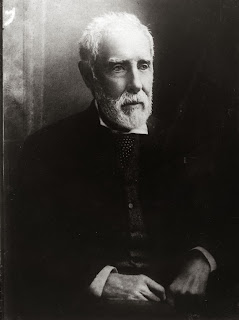
Politician, linguist, collector, soldier and explorer, Sir George Grey is an important figure in New Zealand history. He was the most influential of New Zealand’s governors, serving in the role from1845 -1853 and again in1861 - 1868. Grey started off as an army officer in Ireland before leading an exploring expedition in Western Australia in the late 1830s. His established himself as a very able colonial politician during his governorship of South Australia from 1840-1845. This helped him secure the position of Governor of New Zealand. Between his two terms in New Zealand he was also Governor of the Cape Colony in South Africa from 1854-1861. Ref: 4-1341, portrait of Sir George Grey, c.1812-1898, Sir George Grey Special Collections Despite his successes, he is seen by some as a controversial figure. Historian James Belich called him "a strange, complicated man, whose real charisma and genius almost matched his flaws”. He was however a great benefactor to the Auckland Fr...